
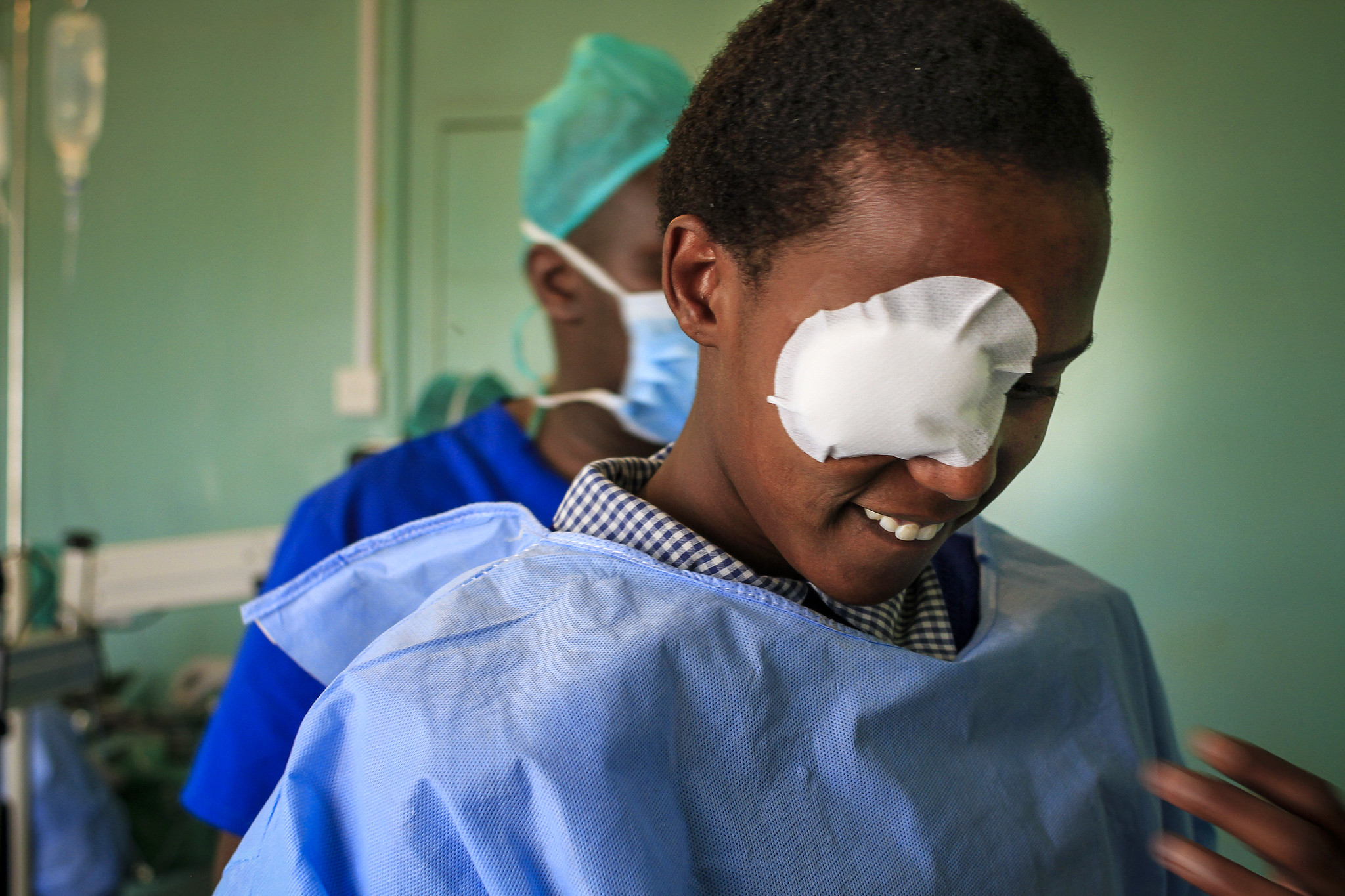
Photograph: Lindsay Hampton
Around the world, more than 100 million people are currently affected by sight loss due to cataract. Most cataracts can be treated with a safe and affordable 15-minute surgery, yet half of all people with the condition have no access to services.
New research, coordinated by the International Centre for Eye Health (ICEH), has shown that millions of people are dying without ever having their cataracts treated, and global targets to address the challenge will be missed at the current rate of progress.
In 2021, The World Health Assembly set an ambitious target for an increase of 30 percentage points in effective cataract surgical coverage (eCSC) by 2030. eCSC measures the proportion of people in a population who have received surgery and achieved a good visual outcome, among all those in need of surgery.
Research published today in The Lancet Global Health shows that global progress is expected to fall well short of the agreed 30 percentage point target.
The authors analysed 233 population-based eye health surveys from 68 countries conducted between 2003 and 2024 to estimate eCSC. Despite some countries showing good progress between surveys (Qatar improved by 26.8 percentage points between 2009 and 2023, and is currently at 78%), modelled estimates show that most WHO regions are projected to see only modest increases. Worldwide, eCSC is predicted to increase by only 8.4 percentage points between 2020 and 2030, well short of the 30 percentage-point target.
In the African region, which has one of the highest age-standardized prevalences of cataract-related blindness, eCSC for 2025 was estimated at 23.6%, and predicted to increase by only 4 percentage points between 2020 and 2030.
From the available data, the authors estimated that at least 50% of non-good outcomes from cataract surgery were likely to be preventable or treatable. For example, addressing uncorrected refractive error (i.e. a need for glasses after surgery) could increase global eCSC by 3.7 percentage points.
In high-income areas it is expected that people who develop cataracts will have them treated within an appropriate timeframe. However further evidence, published today in the Lancet Healthy Longevity, has shown that in Kenya the majority of people who have cataract will die before being treated (without an increase in surgical rates).
These results are despite Kenya having one of the better-performing cataract service delivery systems in sub-Saharan Africa, and an estimated eCSC close to the median for the African region in 2025.
The research, led by ICEH and the Ministry of Health Kenya, used a dynamic model to estimate the number of people who will die before receiving cataract surgery, using Kenya as a case study. The model estimated the national cataract backlog based on ten recent population surveys, the current volume of cataract surgeries nationally, and mortality over a 50-year period (1990–2040).
At current surgical capacity, the model estimates that 77% of individuals on Kenya’s cataract backlog in 2025 will die before receiving surgery. Over a 5-year period (2025–2029), for every cataract surgery performed, four individuals are expected to die without having received treatment.
Ensuring that everyone who has cataract is treated before they die by 2030 in Kenya would require a ten-fold increase in cataract surgical rate to over 7000 per million people per year (up from 702). Cataract surgical rates of this level have been reached in some low and middle-income countries, but are currently unviable in many others. For instance, the surgical rate in Pakistan is currently 5307 and 510 in Somalia.
Collectively the results are a call for further action over global cataract, which accounts for 45% of all blindness.
There is an urgent need to sustainably increase cataract surgical services. Authors of both papers make recommendations for improving the state of care:
- Cataract services globally must be scaled up, with investment in infrastructure and training personnel
- Access to existing care should be prioritised and improved, and cases detected earlier through screening and stronger, integrated health systems
- Making surgery more affordable and providing financial risk protection will increase coverage
- Implementing routine monitoring at facility level can drive improvements in surgery quality
- Data from more countries can improve estimates of progress towards the global eCSC target for 2030
- Better integration of cataract and refractive error services offers the potential to increase both eCSC and another WHA indicator, effective refractive error coverage (eREC) simultaneously
Cataract surgical quality improvement is crucial. Guidelines published by WHO today, Summary of recommendations for quality of care in cataract surgery management, provide a template for countries to improve quality of care in cataract surgery management. The guide recommends improvements across pre-, intra-, and post-operative care, including hygiene, consent and monitoring. The guidelines stress the importance of people-centeredness, safety, timeliness, equity, integration, and efficiency in cataract surgery management. The use of WHO guides, such as the Eye Care Situation Analysis Tool (ECSAT) and Eye Care Indicator Menu (ECIM) are key for improving eye health and cataract services.
Publications
McCormick I, Ouchtar Y, Macleod D, Harte A, Cicinelli MV, Sedighi T, Jolley E, Ravilla TD, Gichangi M, Huang Y, Wang N, Salowi MA, Mishra SK, Bourne RA, Resnikoff S, Keel S, Burton MJ, Ramke J on behalf of the eCSC Study Group. Effective cataract surgical coverage in adults aged 50 years and older: empirical estimates from population-based surveys in 68 countries and modelled estimates for 2000–30. Lancet Global Health. February 2026. https://doi.org/10.1016/S2214-109X(25)00435-8
Bastawrous A, Ouchtar Y, Gichangi M, Bitok M, Rono H, Keel S, Foster A, Burton MJ. Prevalence of death in people with vision impairment from cataracts before treatment: a case study from Kenya. February 2026. https://doi.org/10.1016/j.lanhl.2025.100800
Notes
The predicted figures for eCSC refer to the 6/18 threshold for both operable cataract and for a good post-operative outcome, more information available in the publication.
Ninety-six percent of eCSC survey data came from RAAB surveys, which are managed by the International Centre for Eye Health. RAAB surveys also informed the model used for cataract mortality estimates.