The Webinar
Globally, an estimated 800 million people need reading glasses but do not have them. Presbyopia, the age-related loss of near vision, affects 1.8 billion people worldwide, typically beginning around age 40. It results from the eye’s lens losing flexibility, making it difficult to focus on close objects.
Left uncorrected, presbyopia can hinder daily tasks such as reading, using digital devices, and performing work that requires precision, which impacts quality of life and productivity.
Fortunately, ready-made near-vision spectacles are a simple and accessible intervention that cost less than USD 1 to manufacture and can dramatically improve vision. However, these are not readily available to all those that need them.
What can be done to tackle this major global vision challenge?
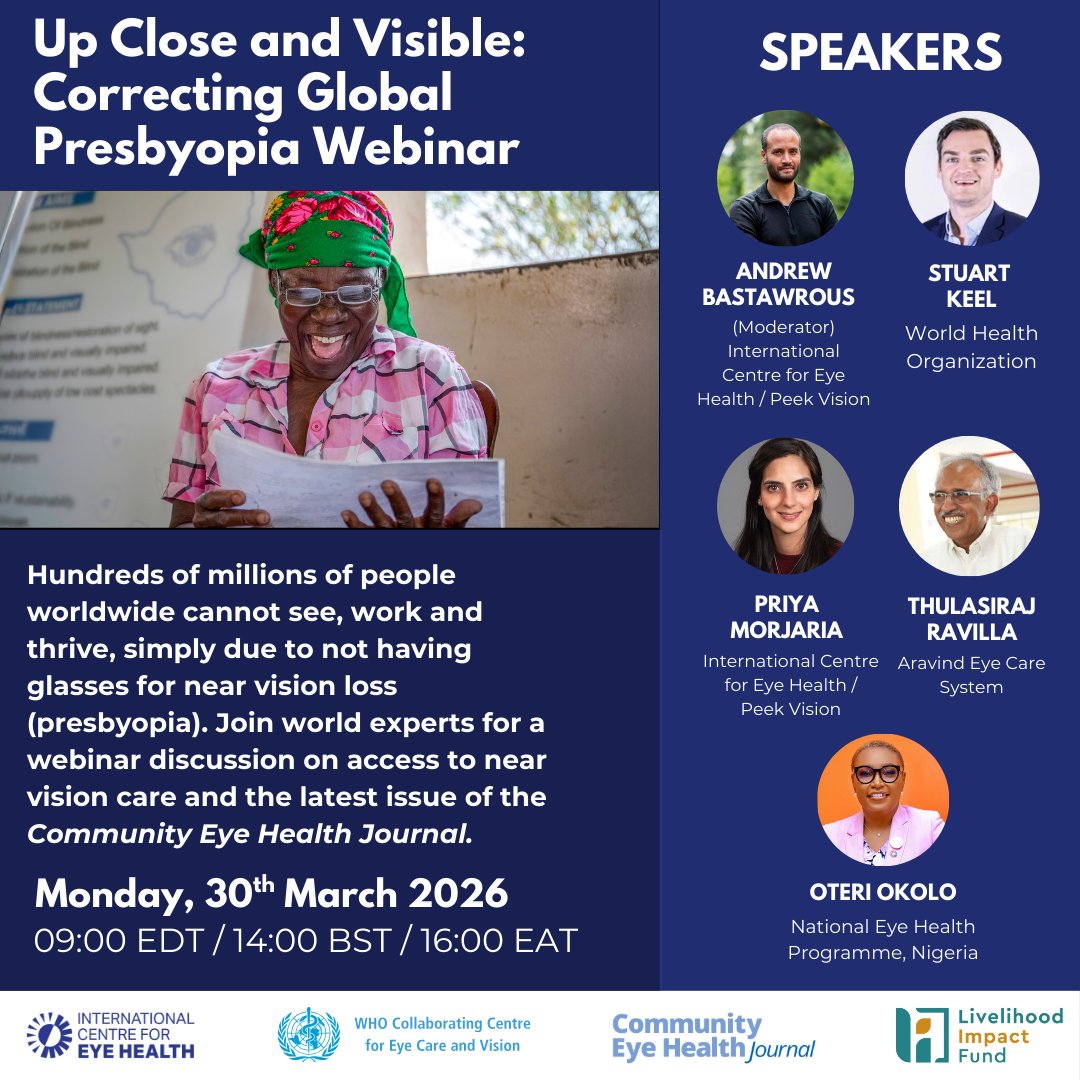
On 30th March 2026, experts from the International Centre for Eye Health, WHO, NGOs and governments came together for a panel on the topic of presbyopia, and to celebrate the publication of a new Community Eye Health Journal edition on the topic. 186 people joined from 69 countries globally.
Recordings and materials
Thank you so much to everyone who contributed in the chat and Q&A. As we were not able to answer all questions within the time, we have developed a ‘Frequently Asked Questions’ document available to everyone here including answers to the Q&A: FAQ
We are also grateful to the following participants, panelists, and organizations that enabled this to happen:
Intro: Abigail Steinberg, Executive Director, Eyeglasses Initiative, Livelihood Impact Fund
Moderator: Andrew Bastawrous Professor, ICEH at LSHTM, & Founder/CEO Peek Vision/Co-Founder Vision Catalyst Fund
Panellists:
-
Stuart Keel, Technical Officer, Vision and Eye Care Programme, WHO
-
Priya Morjaria, Head of Global Programme Development, Peek Vision, & Assistant Professor, LSHTM, UK
-
Thulasiraj Ravilla, Director Operations, Aravind Eye Care System, India
-
Oteri Okolo, National Eye Care Coordinator & Director, National Eye Health Programme, Ministry of Health and Social Welfare, Nigeria
Session takeaways
Enabling access: Across the conversation, one theme kept emerging: we are no longer asking if access can be expanded, but how fast we can do it.
“If people need a specialist to get a simple pair of near vision glasses… we’re excluding those who could solve their problem very quickly.” — Priya Morjaria
“You now have another channel through which you can push the agenda of comprehensive care… looking at it as an opportunity… we will make tremendous progress.” — Thulasiraj Ravilla
“The importance of innovative models is something that we’ve recognised also at WHO, and one of the key partnerships that we set up under the SPECS initiative was with the Universal Postal Union, recognizing that the postal services are a sort of trusted provider within communities, and in particularly underserved rural communities as well, to try to get access to these populations.” – Stuart Keel
These perspectives reflect a shift already in motion toward practical, inclusive approaches that meet people where they are.
Gateway towards broader eye health care: Presbyopia is increasingly being recognized as a powerful entry point for change:
-
Simple, affordable solutions that can scale quickly
-
Flexible delivery models across community, primary care, and retail channels
-
A clear pathway to strengthen broader eye health systems
“It’s not just about handing out spectacles alone. So, for us in Nigeria, we’re using this model to drive access to primary eye care as a whole…These primary healthcare workers can actually point members of the community to where they can access care.” – Oteri Okolo
Turning ideas into action: tools and approaches to enable scale
What’s especially encouraging is that many of the tools needed already exist and are being used today:
-
WHO resources are supporting training, standardization, and integration
-
Peek Vision’s tools are enabling community-based screening at scale
-
Partners are demonstrating how access points can expand while strengthening referral pathways
-
Livelihood Impact Fund resources shared regularly on: LinkedIn, Newsletter, Email