
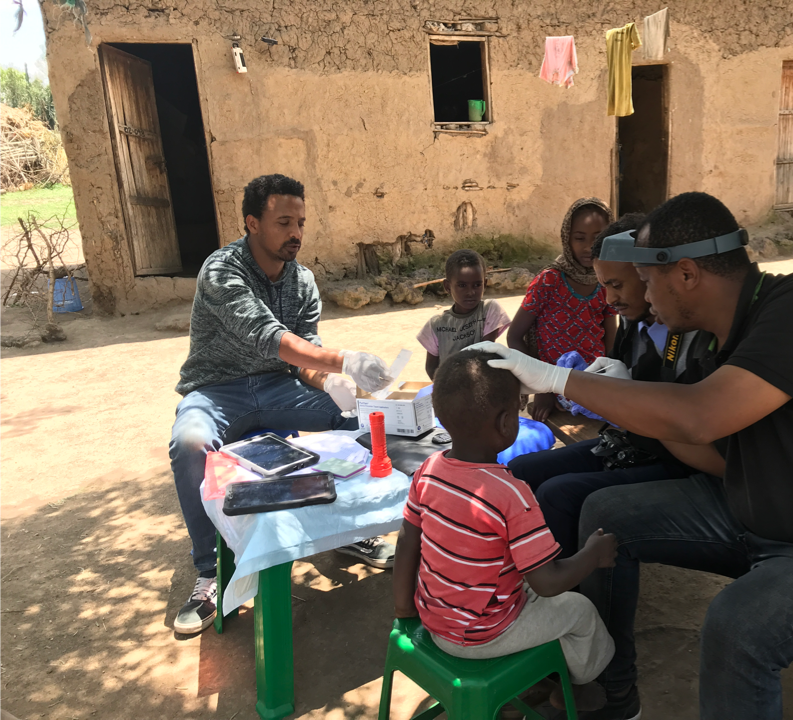
A major new trial investigating enhanced trachoma control approaches has been published in The Lancet Infectious Diseases and Lancet Global Health. The multi-year study analysed the effect of increasing antibiotic treatment for the infection and strengthened transmission reduction methods amongst thousands of people at risk of the disease in Ethiopia. Levels of key causative bacteria for the disease were reduced by around 80%, despite enhanced methods not demonstrating an additional benefit.
Trachoma, a Neglected Tropical Disease, is the most common infectious cause of blindness worldwide. It is caused by the bacterium Chlamydia trachomatis (Ct). Repeated infections produce scarring in the upper eyelid, leading to the eyelashes turning inwards. These then scrape the cornea, resulting in pain and blindness.
Trachoma is endemic in 30 countries, with around 100 million people living in districts requiring interventions to control the disease and therefore at risk of sight loss. Children are the main carriers and spreaders of Ct infection.
The World Health Organization (WHO) recommends the ‘SAFE’ Strategy for trachoma control and elimination: Surgery for trichiasis (the folding in of the eyelids), Antibiotics to treat Ct infection, Facial cleanliness and Environmental improvement to suppress transmission.
Multiple rounds of SAFE implementation have proven insufficient to eliminate trachoma in several countries including Ethiopia, where over 50% of the global trachoma burden remains.
Led by the International Centre for Eye Health (ICEH) at the London School of Hygiene & Tropical Medicine (LSHTM) with partners The Fred Hollows Foundation, the Ethiopia Ministry of Health and the Oromia Health Bureau, the work aimed to assess whether enhanced interventions for the A, F and E components of the strategy could reduce the levels of Ct bacteria and the presence of active trachoma in children.
The seven-year research programme, Stronger-SAFE, assessed the routes of transmission of Ct in a population in the Oromia region of Ethiopia, before designing interventions that could lead to a reduction in levels of the bacterium:
• Enhanced A intervention – giving two doses (over two weeks – rather than one dose once) of the antibiotic (oral azithromycin) administered annually
• Enhanced F intervention – increasing the frequency and quality of face washing with soap, particularly amongst children 1-6
• Enhanced E intervention – reducing fly-eye contact through the use of insect-repellent headwear and household fly traps
Interventions were co-developed with communities and trachoma programmes, and pilot-tested for efficacy, feasibility and acceptability. The trial achieved excellent engagement with communities, resulting in high coverage of enhanced F&E interventions during the study.
Between March 2021 and August 2024, a total of 4,419 children aged 1-9 were examined at baseline and 3,480 at the end, with children split between four arms: 1) standard A with standard F&E (control), 2) standard A with enhanced F&E, 3) enhanced A with standard F&E and 4) enhanced A with enhanced F&E (Stronger SAFE).
During the trial, the prevalence of ocular Ct infection reduced from 14.6% to 2.7% in the control and 13.3% to 2.2% in the Stronger SAFE group. There was no significant difference between the two arms in terms of Ct prevalence, load or signs of clinical trachoma.
For the ‘F’ face-washing interventions, observations and surveys revealed that face washing that used soap increased by 21 percentage points after 24 months, with an increase of seven percentage points in face washing overall.
Overall, Ct prevalence was reduced by approximately 80% from baseline, irrespective of intervention group. This demonstrates that even in remote rural areas, standard SAFE methods with a single annual Mass Drug Administration can successfully reduce infection when implemented with good coverage. However, the authors note that achieving a high coverage of standard SAFE in practice is often difficult. This study did not find evidence that increasing the amount of MDA, to two doses given two weeks apart, was any more effective.
Collectively, the outcomes provide robust evidence for trachoma programme managers and policymakers to accelerate progress towards global trachoma elimination.
Dr Anthony Solomon, lead for trachoma control at the World Health Organization, said: “These results are encouraging. They demonstrate that even in one of the most challenging environments for trachoma elimination, diligent implementation of standard approaches can result in substantial reductions in infection and disease. The findings will help to inform WHO’s guidance for trachoma-endemic countries worldwide.”
This is the only trial to test the combined intervention package of community-wide double-dose azithromycin (two weeks apart), targeted fly control, and hygiene behaviour change, compared to standard trachoma elimination approaches.
“The evidence from Stronger-SAFE is very relevant for trachoma control programmes in Ethiopia and many other countries worldwide. The study reinforces how trachoma can be controlled through well-implemented SAFE measures and provides key evidence for future work. This reduction in trachoma can promote the community’s health and economic aspects.” Said Tesfahun Bishaw, NTD Program Lead at the Federal Ministry of Health Ethiopia.
Eighty-five percent of the magnitude of active trachoma is concentrated in Sub-Saharan Africa, and the condition results in an estimated US$ 8 billion/year in productivity losses. Improved methods for trachoma control could unlock development in many regions and prevent millions from unnecessary and painful blindness.
Professor Matthew Burton, principal investigator for the trial said: “Infectious causes of sight loss like trachoma should become a thing of the past. Ensuring we have robust ways to tackle this challenge will increase quality of life for millions and contribute towards the eventual elimination of this disease for all.”
The project was funded by the Wellcome Trust and the Children’s Investment Fund Foundation.
Publications
Last A, Shafi Abdurahman O, Greenland K, Robinson A, Etu ES, Butcher R, Guye M, Legesse D, Nuri KT, Shuka G, Yusuf MHM, Dheressa G, Dumessa G, Abera H, Bekele M, Akalu M, Tadesse M, Kumsa DA, Gebretsadik FS, Collin C, Czerniewska A, Versteeg B, Habtamu E, Dodson S, Abashawl A, Alemayehu W, Solomon AW, Weiss HA, Logan JG, Macleod D, Burton MJ. Double-dose azithromycin mass drug administration, facial cleanliness, and fly control measures for trachoma control in Oromia, Ethiopia (Stronger SAFE): a cluster-randomised controlled trial. The Lancet Infectious Diseases. March 2026. https://doi.org/10.1016/S1473-3099(26)00024-1
Greenland K, Etu ES, Collin C, Abdurahman OS, Abashawl A, Bertarti SN, Kedir N, Guye M, Czerniewska A, Adugna D, Dodson S, Alemayehu W, Macleod D, Last A, Burton MJ. Evaluation of a face-washing behaviour change intervention for trachoma prevention in Oromia, Ethiopia (Stronger SAFE): secondary outcomes of a cluster-randomised controlled trial. The Lancet Global Health. March 2026. https://doi.org/10.1016/S2214-109X(26)00013-6