
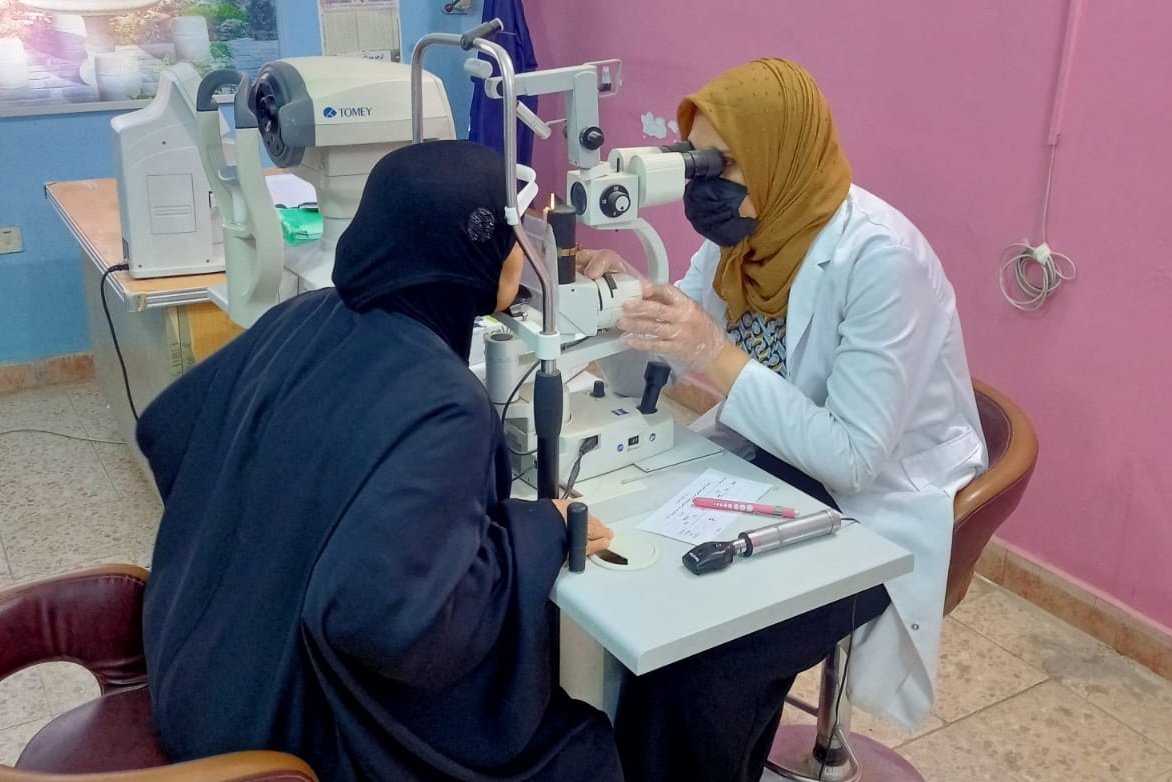
Photograph: Ibtisam Abed Hamel Eye Health and Blindness Prevention Unit Specialist/ Ministry of Health, Iraq
A recently published regional analysis highlights stark disparities in the availability of eye care professionals and cataract surgical services across the Eastern Mediterranean Region (EMR) and Middle East and North Africa (MENA). The study, appearing in AJO International and part of an International Centre for Eye Health Public Health in Eye Care Master’s degree project, draws on publicly available data from 25 countries to explore how ophthalmic workforce distribution relates to the cataract surgical rate (CSR) — a key indicator of access to cataract services.
Cataract remains a leading cause of vision impairment globally, and ensuring adequate surgical capacity is critical for eliminating avoidable blindness. Yet, the new analysis reveals broad variation within and between countries in this part of the world. Ophthalmologist densities ranged dramatically, from fewer than 1 per million population in countries such as Somalia and South Sudan to 70 per million in Saudi Arabia.
A clear positive relationship emerged between the number of ophthalmologists and the CSR, defined as the number of cataract operations performed annually per million people, but only for up to around 20 ophthalmologists per million population. Beyond this point, additional specialists did not correlate strongly with higher surgical output, suggesting that workforce numbers alone are not the sole determinant of service provision.
In practical terms, measurements of productivity, captured as the average number of cataract surgeries per ophthalmologist per week, also varied widely across countries, ranging from less than one to 22 procedures per week. Iran and Pakistan stood out for having both relatively high CSRs and high surgical productivity despite having moderate densities of ophthalmologists.
The authors draw attention to notable gaps in data on other eye care professionals such as optometrists and allied personnel, which limited deeper understanding of the full eye care workforce beyond ophthalmologists. Such gaps underscore the need for better regional workforce analytics.
These findings have important implications for eye health planning. They suggest that improving efficiency and equitable distribution of services, in addition to increasing the number of trained specialists, will be essential to meet the growing needs of ageing populations across the EMR-MENA region. The authors also advocate for wider use of effective cataract surgical coverage (eCSC) — an indicator that integrates surgical output with outcomes and equity — to better monitor and guide regional eye care performance.
As countries in the region work toward Vision 2030 goals and Universal Health Coverage, strengthening workforce planning, training, and service delivery models will be critical to ensuring that cataract services are both accessible and effective for all.
Publication
Shakarchi F, Buchan J, Foster A. Workforce distribution and cataract surgical rates in the eastern mediterranean (EMR) and middle east north Africa (MENA) regions. AJO International. December 2025. https://doi.org/10.1016/j.ajoint.2025.100200