
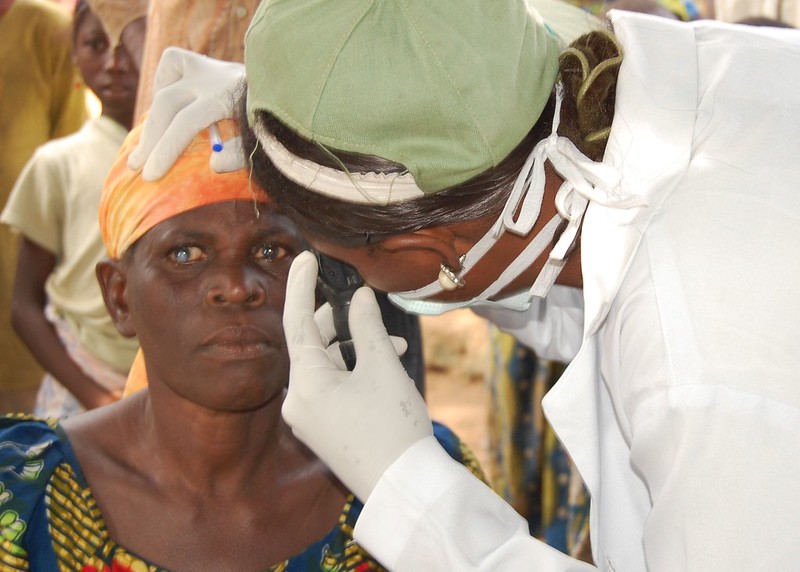
Corneal opacity (Nigeria). Photograph: Dr Ebeogu Ogochukwu Wisdom / The Eyesavers Network International
A new nationwide study published in the British Journal of Ophthalmology has found that nearly one in 10 adults aged 35 years and older in The Gambia are living with corneal opacity (CO), highlighting the continuing burden of corneal disease despite major progress in eliminating trachoma.
Corneal opacity, the scarring or clouding of the cornea, is a major cause of vision impairment and blindness globally, particularly in Africa and Asia. Researchers note that while public health programmes have successfully reduced conditions such as trachoma and vitamin A deficiency, other causes of corneal disease, including infection and trauma, remain major challenges.
The study, including researchers from the International Centre for Eye Health, analysed data from The Gambia’s 2019 National Eye Health Survey, which examined 9,188 participants selected through nationally representative sampling. Researchers identified 835 participants with corneal opacity in one or both eyes, corresponding to an age- and sex-adjusted count of 878 and a prevalence of 9.6%. This equates to an estimated 50,030 people aged 35 years and older living with corneal opacity nationally.
Corneal opacity was substantially more common in one eye than both eyes. While bilateral disease affected 2.2% of participants, 7.3% had monocular corneal opacity. The authors note that this is important because many blindness surveys focus only on vision in the better-seeing eye, potentially underestimating the true burden of corneal disease and its impact on daily life.
The study found that corneal opacity frequently caused severe visual loss in the affected eye. Among participants with monocular corneal opacity, 21% were blind in the affected eye and a further 15.6% had moderate or severe vision impairment. Among those with bilateral corneal opacity, almost half had some degree of vision impairment in their better-seeing eye.
Several important risk factors were identified. Corneal opacity was strongly associated with trachomatous trichiasis, with affected individuals more than five times more likely to have corneal opacity than those without trichiasis. Older age, male sex, and living in rural areas were also independently associated with increased risk.
Although The Gambia became the second country in sub-Saharan Africa to eliminate trachoma as a public health problem, the study shows that trachoma-related disease continues to leave a long-term legacy. The authors found that trachoma itself now accounts for a much smaller proportion of blindness than in previous national surveys, but that overall blindness from corneal disease has remained relatively unchanged because of continuing non-trachomatous corneal disease.
The researchers also highlight that the true burden of corneal disease may still be underestimated, particularly among children and younger adults, who were not included in the survey. Many cases of lifelong corneal blindness begin early in life following infection, trauma, or harmful traditional practices.
The authors conclude that focused national efforts are urgently needed to prevent and treat conditions leading to corneal opacity, including infectious corneal ulceration, trauma, and trachomatous disease. They also call for further research to better understand the causes of corneal opacity in The Gambia and to develop approaches for rehabilitation and vision restoration in affected individuals.
Publication
Erima D, Taylor EH, Okoh JA, Olaniya SI, Bell SJ, Kirkpatrick B, Bobat H, Bascaran C, Cassels-Brown A, Faal H, Kim MJ, Mactaggart I, Hydara A, Burton MJ. Prevalence and risk factors associated with corneal opacity in The Gambia. British Journal of Ophthalmology. May 2026. https://doi.org/10.1136/bjo-2025-328816