
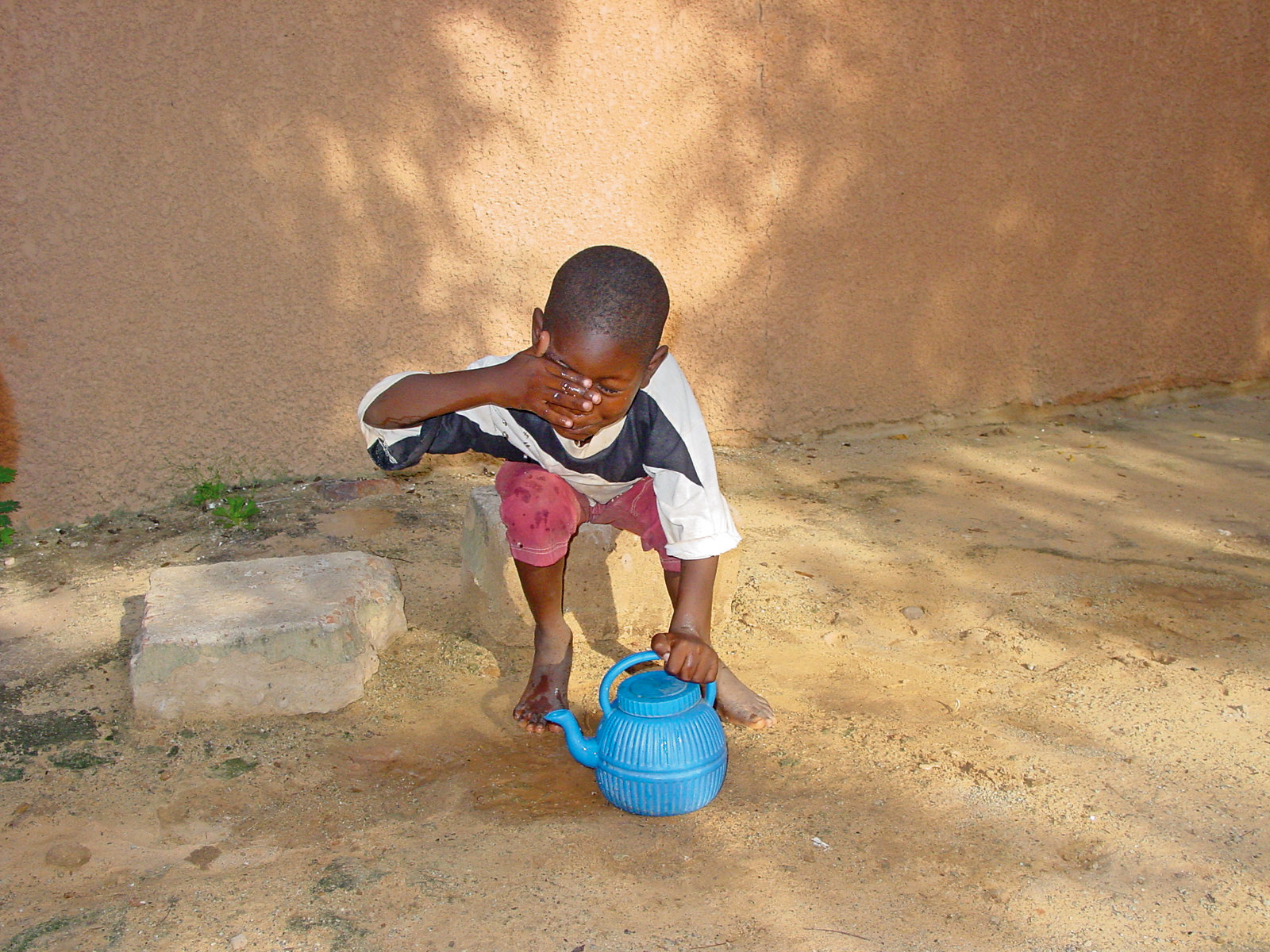
Face washing. Photograph: John Buchan
A new randomised trial has found that three different face-washing methods, using water alone, water with soap, or a damp antimicrobial microfibre towel, were equally ineffective at removing Chlamydia trachomatis DNA from the faces of children with severe active trachoma. The findings highlight important gaps in understanding how facial cleanliness contributes to trachoma control and point to the need for further research to strengthen one of the four pillars of the WHO SAFE strategy.
Facial cleanliness has long been promoted alongside surgery, antibiotics and environmental improvements as part of efforts to eliminate trachoma. However, surprisingly little evidence exists on the most effective way to wash children’s faces to reduce transmission of C. trachomatis, the bacterium that causes the disease.
Researchers from the International Centre for Eye Health working in Oromia, Ethiopia, screened 14,716 children aged 1 to 7 years, enrolling 470 children with severe active trachoma into the trial. Children were randomly assigned to have their faces washed with water only, water and soap, or a damp antimicrobial microfibre towel (SuperTowel). Because the study specifically investigated bacterial removal, the primary analysis focused on the 25 children who had both confirmed ocular C. trachomatis infection and detectable bacteria on their faces.
Immediately after washing, all 25 children still had detectable C. trachomatis DNA on their faces, regardless of which washing method had been used. Although bacterial loads fell overall after washing, there was no significant difference between the three approaches, and all children who were positive at the start of the study again had detectable facial C. trachomatis eight hours later.
The results did not mean that face-washing had no benefit. All three washing methods visibly improved facial cleanliness by removing dirt and ocular or nasal discharge. Independent reviewers judged 84% of faces to be cleaner after washing, even when some discharge remained visible. Water with soap removed visible discharge completely in 50% of children, compared with 9% using water alone and 20% using the damp towel, although these differences were not statistically significant because of the small sample size.
The study also examined whether face-washing reduced contamination on children’s and caregivers’ hands. Some C. trachomatis was removed from hands, but most participants who had bacteria on their hands before washing still had detectable DNA afterwards, with no clear advantage for any washing method.
One of the study’s most important findings was the unexpectedly low prevalence of active infection. Although researchers enrolled children with severe clinical signs of trachoma, only 33 of 470 children (7%) had confirmed ocular C. trachomatis infection, and just 25 children met the criteria for the primary analysis. The authors note that this reflects a growing body of evidence showing that clinical signs of trachoma can persist even after bacterial infection has become uncommon, making it increasingly difficult to identify infected children for intervention studies.
The researchers stress that their findings should not be interpreted as evidence that facial cleanliness is unimportant for trachoma control. Rather, the study measured the persistence of bacterial DNA rather than whether bacteria remained alive and capable of causing infection. They conclude that more research is needed to understand how face-washing reduces transmission, whether different approaches can more effectively remove infectious material, and how facial cleanliness interventions can best support global efforts to eliminate trachoma.
Publication
Greenland K, Butcher R, Etu ES et al. A Randomised Trial of Three Face-Washing Methods for the Removal of Chlamydia trachomatis From the Faces of Children With Severe Active Trachoma. Tropical Medicine & International Health. January 2026. https://doi.org/10.1111/tmi.70078