
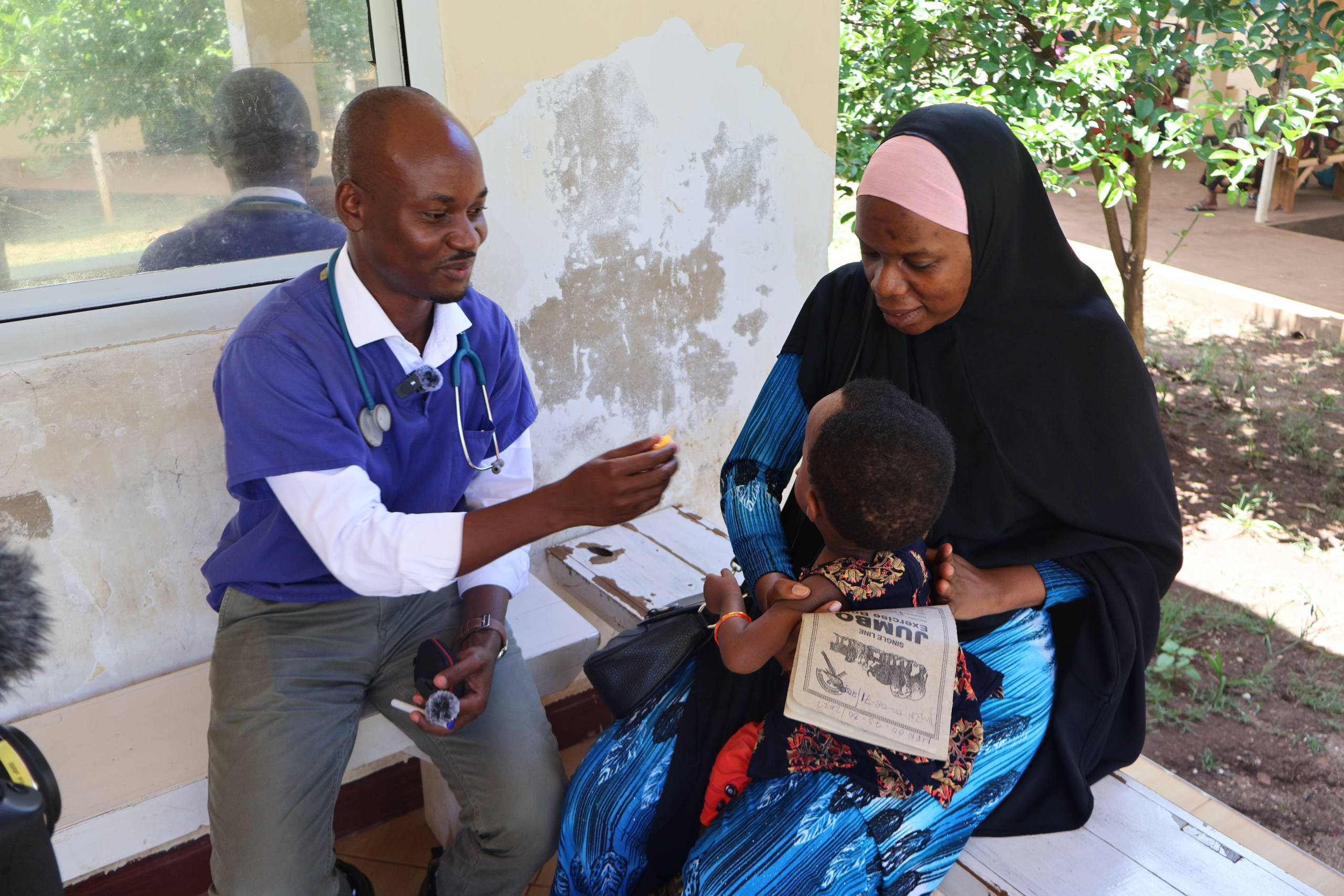
Child eye health appointment in Tanzania. Photograph: Hugh Bassett
New research from Tanzania has provided insights into how different strains of Chlamydia trachomatis, the bacterium that causes trachoma, behave over time and following mass drug administration, with potential implications for future trachoma control and vaccine development.
The four-year longitudinal study, involving researchers from the International Centre for Eye Health and Kilimanjaro Christian Medical Centre in Tanzania, followed children living in three rural villages in a trachoma-endemic area of northern Tanzania. Researchers repeatedly tested children for Chlamydia trachomatis (Ct), examined them for clinical signs of trachoma, and took genetic profiles of the infections.
Trachoma remains the world’s leading infectious cause of blindness. The global SAFE strategy, which includes mass drug administration with the antibiotic azithromycin, has driven major progress towards elimination. However, transmission can persist or return in some communities following treatment, making it important to understand the characteristics of the bacteria and immune responses that may contribute to this.
The original cohort included 616 children aged 6 to 10 years, who were followed between 2012 and 2016, with sampling planned every three months. Communities received three annual rounds of azithromycin MDA, while one village received a fourth because trachoma prevalence remained above 15%. Across the study, 7,640 conjunctival swabs underwent diagnostic testing.
The researchers then examined the genetic characteristics of Ct infections, focusing on different forms known as genovars. Of 7,856 specimens included in the reported infection analysis, 593 (7.7%) tested positive for Ct and 449 infections from 237 individuals were successfully genetically sequenced. Infection prevalence fell from 15.4% at baseline to 4.8% four years later, although prevalence fluctuated considerably during the intervening period.
One of the clearest findings was a change in the types of Ct circulating over the study period. Before the first MDA round, 94% of successfully typed infections were genovar B or Ba. After the first MDA, genovar A became dominant, accounting for 78% of infections in subsequent years. Genovar A infections also had a substantially higher average bacterial load than B/Ba infections.
Different genovars were also associated with different clinical characteristics. Genovar B was significantly associated with follicles, papillae and conjunctival scarring, with particularly strong associations seen for scarring. However, the researchers caution that genovar B was predominantly found before MDA, when clinical signs were also more severe, making it difficult to separate the effects of bacterial genotype from the timing of treatment. No factors examined in the study were significantly associated with progression of scarring.
The longitudinal study also provided an opportunity to examine what happened when children experienced Ct infection more than once. Among 121 people with recurrent infections, 83% were infected with the same genovar and 77% with the same more-specific genovariant. Most had received treatment before becoming infected again. The authors suggest that the repeated detection of identical or near-identical strains could indicate that people do not develop sufficient protective immunity to reliably prevent reinfection, although persistent infection is another possible explanation.
The researchers also found that the diversity of Ct genovariants increased after MDA in two of the three villages when adjusted for the number of infections. This could indicate continuing transmission or the introduction of strains into the communities, although the authors emphasise that the relationship between bacterial genetic diversity, transmission and immunity remains uncertain.
Understanding these differences could also be relevant to the development of a future trachoma vaccine. The genetic variation studied occurs in the ompA gene, which encodes the Major Outer Membrane Protein (MOMP), an important target for the immune system and a focus of current vaccine research. Genovars A and B belong to different immunological groups, meaning that understanding immune responses to different circulating strains may be important when developing vaccines capable of providing broad protection.
The findings highlight the complexity of eliminating trachoma in communities where infection persists. While MDA substantially reduces the community reservoir of infection, the study shows that the strains circulating within a population can change over time and that repeated infection with the same or closely related strains can occur after treatment. The researchers conclude that a better understanding of strain-specific immunity and virulence could help inform both future trachoma control strategies and efforts to develop an effective vaccine.
Publication
Harte AJ, Mafuru E, Tamdhani A … Mtuy T … Burton MJ, Holland MJ. Chlamydia trachomatis ompA Genotype and Clinical Signs of Trachoma in a Longitudinal Tanzanian Cohort. Pathogens. July 2026. https://doi.org/10.3390/pathogens15070705