
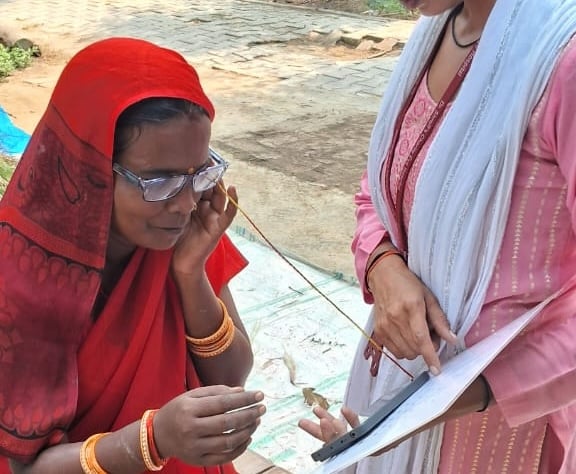
Vision testing in rural India. Photograph: Mohd Javed
Researchers have demonstrated a new approach to eye health planning that brings together data on how many people need eye care with information on the services available to meet that need.
The study, involving researchers from the International Centre for Eye Health (ICEH) at the London School of Hygiene & Tropical Medicine and Dr Shroff’s Charity Eye Hospital in India, provides the first real-world implementation of a newly developed Health System Module for the Rapid Assessment of Avoidable Blindness (RAAB).
Published in PLOS One, the research was conducted in a predominantly rural area of Uttar Pradesh in northern India, covering a population of approximately two million people. It combined a population-based RAAB survey with information collected from eye care providers across the same area.
RAAB is widely used around the world to rapidly estimate the prevalence and causes of blindness and vision impairment in people aged 50 and over. While this provides valuable information on population need, planning services also requires an understanding of what care is currently available.
The new Health System Module was developed to help bridge this gap. It collects structured information from government and non-government providers on the availability, capacity and quality of services for three major causes of vision loss: cataract, uncorrected refractive error and diabetic retinopathy.
A substantial unmet need for eye care
The researchers examined 3,867 people aged 50 and over, representing 94.4% of those selected for the survey. Age- and sex-adjusted prevalence of blindness was 2.2%, while 29.5% of participants had some degree of vision impairment. Blindness was significantly more common among women, at 2.8%, compared with 1.6% among men.
Most of this vision loss was avoidable. Unoperated cataract accounted for 76.5% of blindness, 84.3% of severe vision impairment and 54.7% of moderate vision impairment. Uncorrected refractive error was responsible for 79.2% of mild vision impairment.
When the survey findings were extrapolated across the catchment population, the researchers estimated that more than 100,000 people aged 50 and over had some degree of vision impairment or blindness, including more than 40,000 people with bilateral vision impairment or blindness caused by untreated cataract.
Importantly, the study showed that a relatively high volume of cataract surgery did not mean that population need had been met. The researchers estimated a cataract surgical rate of 7,165 operations per million people per year, higher than the Indian national average of 5,900 reported for 2022. Despite this, there remained a substantial backlog of people requiring surgery.
Cataract surgical coverage was 59.6% using the 6/12 threshold, but effective cataract surgical coverage, which also takes account of whether surgery restored good vision, was only 37.8%. The resulting relative quality gap was 36.6%.
There were signs that outcomes may be improving. Among people whose cataract surgery had taken place within the previous two years, 74.4% had a good presenting visual acuity outcome, compared with 57.0% among those whose surgery had taken place earlier. The study cannot establish what caused this difference, although the authors suggest improvements in infrastructure and training may have contributed.
Major gaps in refractive error coverage and health system data
The research also identified particularly low coverage for refractive error. Only 14% of people who needed distance glasses had received them, falling to 9.5% among women compared with 19.5% among men. Effective refractive error coverage, which additionally measures whether glasses provide the required improvement in vision, was 11.2% overall.
Combining the population survey with the Health System Module also exposed a different problem: major gaps in the information available to plan and monitor services.
Fourteen eligible eye care providers were identified across the study area. Cataract surgery numbers were available from 12, but only one provider had data on visual acuity before and after cataract surgery. Information on glasses dispensed was available from four providers, while none could provide data on the number of people receiving diabetic retinopathy screening or treatment.
These gaps matter because knowing how many operations or treatments are delivered does not necessarily show whether services are reaching everyone who needs them or producing good outcomes. By putting population need and health system capacity side by side, the approach can reveal gaps that may remain hidden when either is considered alone.
The study also demonstrated some of the practical challenges of using the new module. These included incomplete facility records, difficulties collecting information from small optical shops, limited availability of outcome data and reluctance among some private providers to share information. The researchers say these limitations will need to be addressed to maximise the module’s usefulness for health service planning.
From measuring blindness to planning services
The researchers argue that combining RAAB with the Health System Module could provide governments, eye care organisations and other planners with a more complete picture of eye health at a regional level.
Rather than showing only how much blindness and vision impairment exists, the approach can help identify whether appropriate services are available, where coverage and quality gaps remain, and where better data are needed.
The study is the first to apply the new module in a large, predominantly rural eye care catchment and the first to combine a population-based assessment of vision impairment with a structured, comprehensive assessment of eye care services across the same area. As RAAB is already widely used internationally, the researchers suggest the approach could be adopted more broadly to support planning and strengthen eye health systems.
Publication
Sabherwal S, McCormick I, Javed M, Ramke J … Bastawrous A. Beyond prevalence: A complete catchment eye health system profile using rapid assessment of avoidable blindness, a population-based eye health survey, and the first implementation of the newly developed health system module. PLOS One. August 2026. https://doi.org/10.1371/journal.pone.0354744