
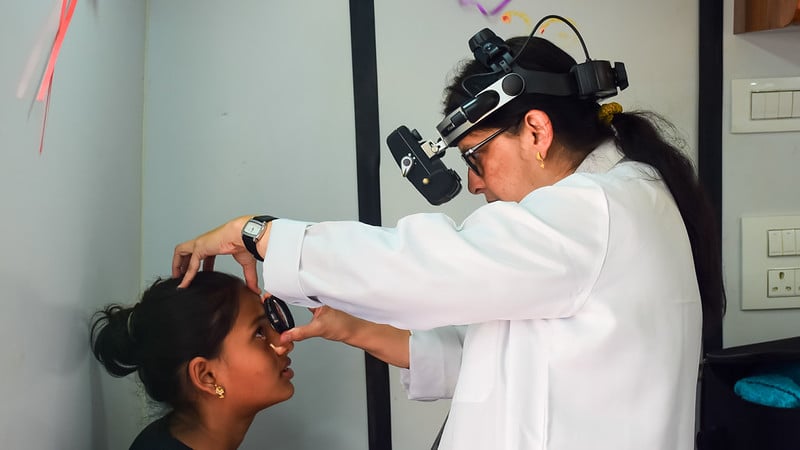
Childhood eye screening in India Photograph: Bhaskar Kulkarni / INFOSYS
A new study in rural India has found that social stigma, limited awareness and financial barriers can prevent children from receiving timely eye care, highlighting the need to address community attitudes alongside improvements to health services.
Published in the Indian Journal of Ophthalmology, the research explored how parents, teachers and community health workers understand children’s eye health, and what influences families’ decisions to seek treatment.
Researchers from Dr Shroff’s Charity Eye Hospital, the University of Manchester, the International Centre for Eye Health and Orbis International conducted the study in Saharanpur district, Uttar Pradesh, where a community-based child eye health programme was being planned.
The team gathered perspectives from 32 participants through 24 individual interviews and a focus group involving eight vision technicians. Participants included parents, schoolteachers, community health workers, Anganwadi workers (who provide community-based nutrition and childcare services) and vision technicians.
The researchers identified three particularly important barriers to accessing care: social influences, gaps in knowledge, and limited resources.
Social stigma emerged as the most prominent barrier. Children wearing spectacles were sometimes teased by their peers, discouraging them from wearing glasses and making parents reluctant to seek treatment.
Misconceptions about eye conditions and their treatment were also common. Some parents believed young children were too young for eye surgery or that visual problems would improve naturally with age. Others relied on traditional remedies rather than seeking professional advice, potentially delaying appropriate treatment.
Financial and practical barriers further restricted access. Even when treatment was free or subsidised, travel costs and time away from work could prevent families from attending appointments.
The study also identified gaps in the knowledge and skills of community health workers and teachers, who may be well placed to recognise children’s eye problems but do not always have the training needed to identify them.
However, researchers found several opportunities to improve access. Community health workers and teachers were trusted sources of information, while follow-up calls, home visits and reminders could help families ensure children continued wearing prescribed spectacles.
The findings have informed proposed improvements to local services, including closer collaboration with Anganwadi centres and schools, additional training for community health workers, and tele-ophthalmology support for vision technicians.
The researchers recommend community education to address misconceptions and stigma, alongside stronger primary and secondary eye care services. They also highlight the importance of involving teachers, families and local health workers in encouraging early identification and treatment.
The authors conclude that expanding services alone is unlikely to overcome all the barriers to childhood eye care. Addressing social attitudes, improving awareness and strengthening community engagement will also be important in ensuring children receive the care they need.
Publication
Sethu S, Sharma B, Sabherwal S, Shroff K, Saini S, Tyagi P, Ganesh S, Borah R. Awareness and perceptions of child eye health services among parents and community stakeholders in rural Uttar Pradesh, India. Indian Journal of Ophthalmology. 2026;74(Suppl 3)–S372. https://doi.org/10.4103/IJO.IJO_3076_25