
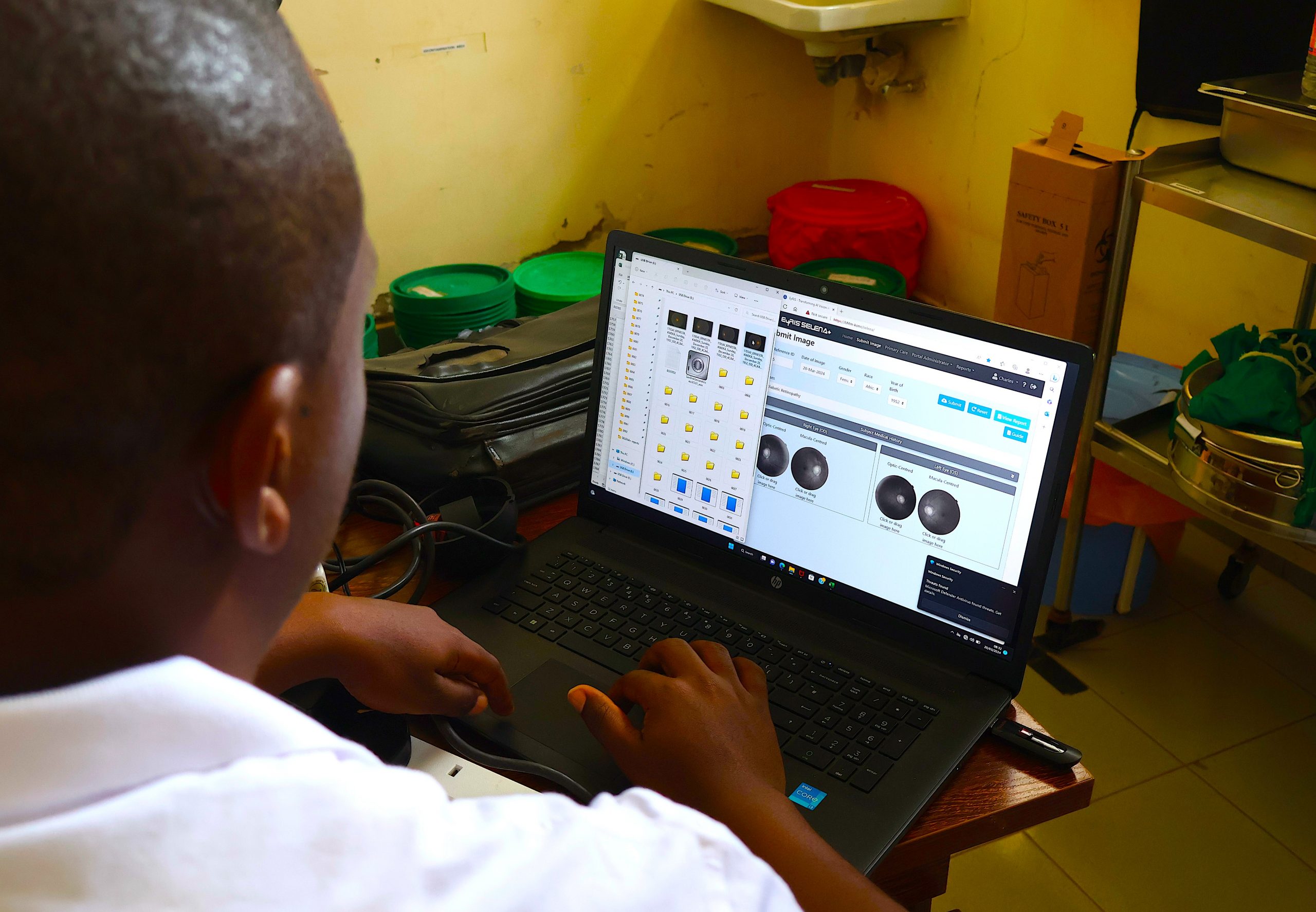
Artificial intelligence has the potential to transform healthcare, particularly in countries facing severe shortages of specialist health workers. But new research led by the International Centre for Eye Health (ICEH) warns that the evidence needed to develop and deploy AI is currently concentrated in countries where specialist capacity is already greater and the burden of blindness is often lower.
Published in NEJM AI, the study mapped more than 6,000 ophthalmology AI research papers against the global distribution of blindness and ophthalmologists. The resulting picture reveals a substantial mismatch between where AI research is taking place and where the need for new approaches to eye care is greatest.
AI has been proposed as one way of addressing global shortages of health workers. Technologies that support clinical decision-making could allow some tasks traditionally performed by specialists to be undertaken by other health workers, potentially extending services to underserved populations. This could be particularly valuable in low- and middle-income countries (LMICs), where shortages can be severe. The paper notes, for example, that the UK has around 33 doctors per 10,000 people, compared with 1.3 in Tanzania.
However, the researchers argue that there is a risk of a paradox: the places that potentially have the most to gain from AI may have the least evidence available to ensure that these technologies work effectively in their populations and health systems.
The team searched four major research databases for ophthalmology AI studies published since 2008. Of 16,886 publications identified, 6,362 were included in the analysis. Almost half came from just two countries. China accounted for 1,824 papers (28.7%) and the United States for 1,225 (19.3%), followed by India with 431, South Korea with 261 and the UK with 216.
The researchers then compared the geographical distribution of this research with the prevalence of blindness and the number of ophthalmologists around the world. The cartograms presented in the paper show a striking contrast: ophthalmology AI research is concentrated largely in countries with greater ophthalmology workforce capacity, while many countries carrying a high burden of blindness have a much smaller AI research footprint.
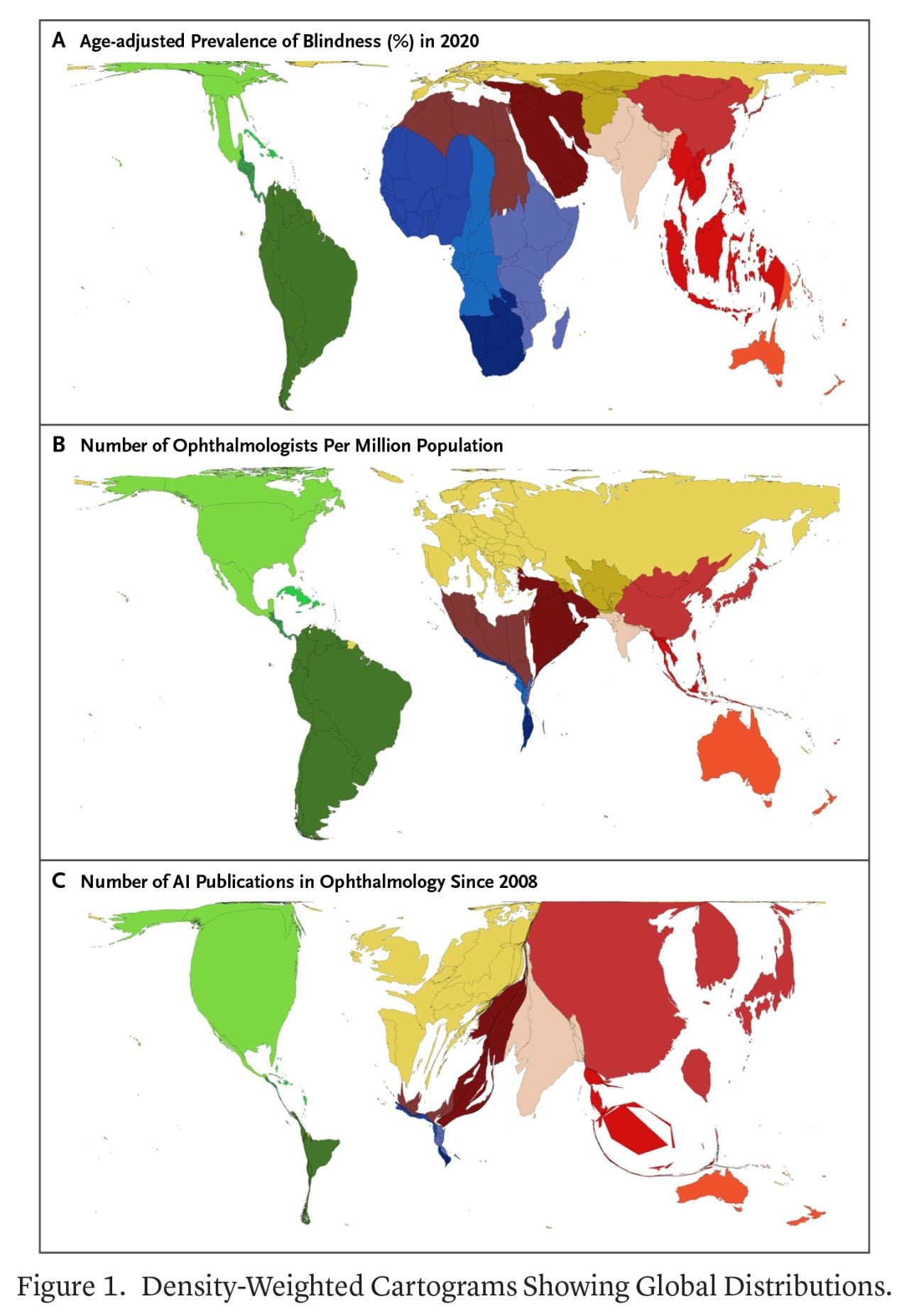
China and India are notable exceptions. Their substantial research output demonstrates that this pattern is not inevitable. The authors highlight how investment in digital infrastructure, technical expertise and national AI strategies can help countries develop their own research ecosystems. They argue that similar deliberate investment will be needed elsewhere if LMICs are to play a greater role in developing and evaluating AI for their own health needs.
Importantly, the study does not show that AI is already increasing health inequalities. Publication numbers indicate where research is taking place, but do not show where AI is being deployed, who ultimately has access to it or whether it improves health outcomes. The authors therefore describe the findings as a warning signal rather than evidence that AI itself is worsening inequality.
The researchers argue that avoiding this outcome will require better representation of LMIC populations in the data used to develop and validate AI, more LMIC-led external validation, and research examining whether technologies are practical and effective in resource-constrained health systems. Investment in local data infrastructure, training and technical capacity through equitable partnerships will also be critical.
AI could ultimately have some of its greatest impact in health systems with the fewest specialists. This study highlights that achieving this potential will require ensuring that countries with the greatest health needs are able to participate in generating the evidence and expertise that shape the future of AI-enabled healthcare.
Publication
Cleland CR, Tsang K, Taylor EH, Thirunavukarasu A, Liu X, Denniston AK, Arunga S, Mathenge C, Bourne R, Macleod D, Bascaran C, Burton MJ. Will Artificial Intelligence Augment Global Health Inequalities? NEJM AI. May 2026. https://doi.org/10.1056/AIcs2600267