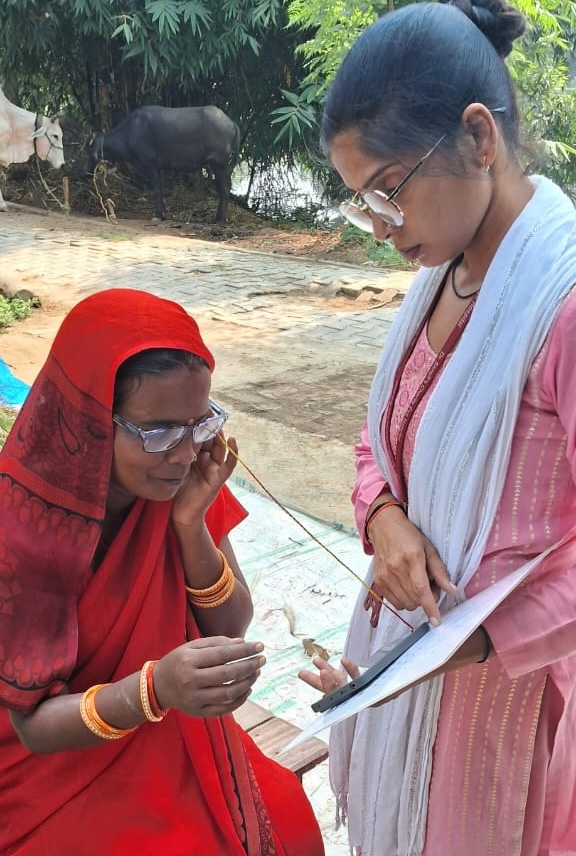
Near vision testing in India Photograph: Mohd Javed
A new study from India shows that a smartphone-based near vision test can be used reliably by trained community screeners, offering a rapid and accurate alternative to conventional near-vision charts. Conducted in the catchment area of Dr. Shroff’s Charity Eye Hospital (SCEH) in Uttar Pradesh, the study, led by researchers from the International Centre for Eye Health in partnership with SCEH and Peek Vision, assessed whether a digital tool can be scaled for community screening programmes.
Peek Vision is an established digital software platform that improves health programme delivery. Among several tests the platform offers, a new near-vision test has previously been validated in a trial setting. This new study assessed the test in the clinic and community:
Stage 1
In the first stage, three trained community screeners tested 168 clinic participants to measure how much the variability of the test differed between screeners (inter-observer variability). An optometrist used a standard ‘Tumbling E’ chart (which together are the current ‘gold standard’ for vision testing), and then this was tested against the results for the community screeners (non-optometrists) using the same chart. Agreement between the screeners using the chart was also tested, and then between screeners using the Peek app.
Screeners were shown to have good agreement between them and the optometrist when using the conventional chart (up to 88% – full results in publication), and between each other when using Peek (up to 98% agreement).
Stage 2
In stage 2, two screeners who had already achieved good agreement with the optometrist performed tests away from the clinic in the community using both methods. This included recording the time taken for each test. Six hundred participants were tested in this way.
Compared to testing with the chart, Peek testing had sensitivity (rate of true positives) of 91.25% and specificity (rate of true negatives) of 99.41%. Test duration was slightly shorter with Peek (mean 40.3 seconds) than with conventional charts (46.6 seconds), supporting its practicality in high-throughput field settings.
Impact
The digital Peek near vision test was found to be reliable in clinic and community settings, strengthening findings from previous trial condition validation.
With appropriate training, community screeners can deliver accurate near vision assessments using a digital app, potentially expanding reach where access to eye care professionals is limited. The high specificity is particularly reassuring for programmes aiming to minimise false positives that could overburden referral services, while the good sensitivity suggests most people with meaningful near vision impairment would be correctly identified.
The short test time and strong inter-observer agreement further strengthen the case for integrating such tools into population screening and research. An extra minute saved during training or screening can mean identifying and helping one more person with near visual impairment—using a user-friendly diagnostic tool that enables timely, cost-effective intervention with near vision glasses.
With more than 800m people globally living with uncorrected near vision, studies that can demonstrate innovative approaches to address the challenge are vital. As eye-health programmes seek scalable, cost-effective methods to detect and manage near vision impairment, including presbyopia (loss of elasticity in eye’s lens), this study offers timely, field-tested evidence that digital testing can meet both operational and accuracy needs.
Publication: Sabherwal S, Javed M, Watts E et al. Near Visual Acuity Measurements by Community Screeners Using Digital (Peek) Testing Versus Conventional Charts in India. Transl Vis Sci Technol. August 2025. https://doi.org/10.1167/tvst.14.8.24