
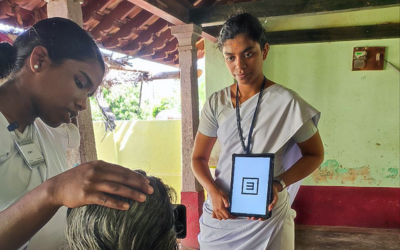
Eye health population survey in India. © Aravind Eye Care
Population-based eye health surveys provide essential information for planning and evaluating eye care services, but participation rates often vary widely between settings. A recent study published in Wellcome Open Research shows that participation in these surveys is consistently lower in high-income contexts compared to low and middle-income countries (LMICs), even as gender balance among participants tends to be stronger in high-income surveys.
The research, led by researchers at the International Centre for Eye Health, analysed data from an existing database of all population-based eye health surveys undertaken anywhere in the world between 2000–2023 that estimated the prevalence of vision impairment. The authors synthesised participation metrics to understand how survey engagement differed by geography, sex and income level of the study setting.
Participation was reported by 374 (86.6%) of the 432 included eye health surveys, and was lowest in high-income countries (79.2%). Just over one-quarter of studies disaggregated participation by gender/sex.
In these studies, women were more likely to participate than men in low-, lower-middle and upper-middle income countries, but not in high-income countries where participation was similar. There was no change in overall participation for studies as a whole during the years analysed.
Lower participation can introduce response bias, i.e. when certain groups are less likely to take part, resulting in estimates that may not accurately represent the broader population. The lower rates in high-income settings may reflect differing survey designs, competing time demands, or differences in how health research benefits are perceived by the public.
The authors highlight that gender balance in survey samples is crucial because many eye conditions, such as cataract, glaucoma and refractive error, can vary by sex and age. Surveys lacking balanced participation risk underestimating disease prevalence in under-represented groups or misinforming service planning. Women may have been overrepresented in LMIC studies as they are more likely to be at home during the door-to-door enumeration step of a population-based survey.
Improving and maintaining overall participation in LMICs remains a priority to ensure that eye health estimates accurately reflect population needs.
Population-based surveys remain a cornerstone of eye health planning globally, but context-sensitive approaches are needed to ensure they yield robust, representative data. As eye care programmes strive to monitor progress toward vision-related Sustainable Development Goals, understanding and addressing participation disparities will be essential for equitable health service planning and evaluation.
Publication
Goodman L, Turnbull P, McCormick I et al. Participation in population-based eye health surveys is lower but more gender-balanced in high- compared to low- and middle-income countries. Wellcome Open Research. April 2025. https://doi.org/10.12688/wellcomeopenres.23976.1