
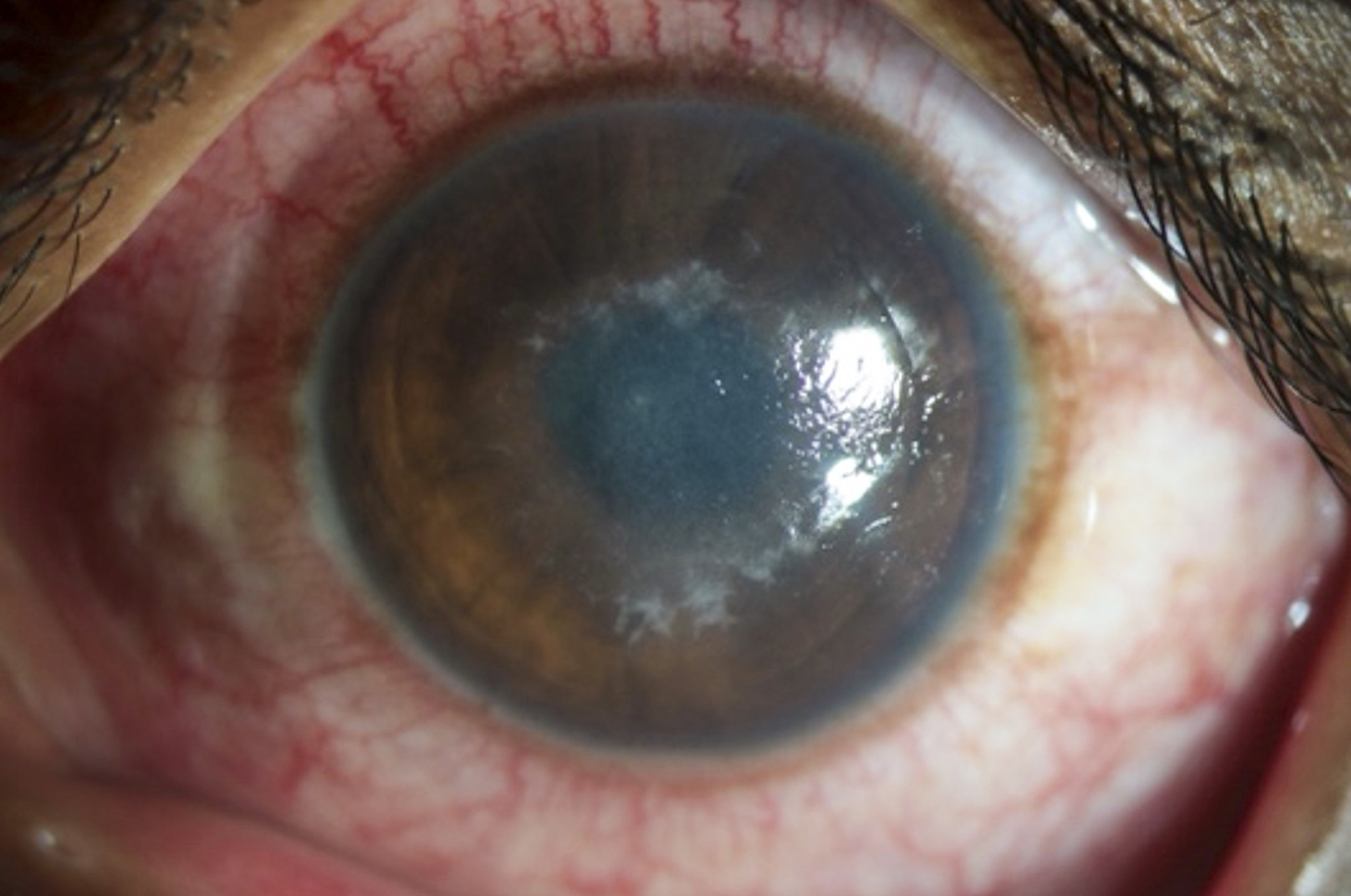
Bacterial keratitis. Photograph: Vineet Joshi
A major new systematic review and meta-analysis published in The Lancet Microbe has brought together evidence from around the world to examine antimicrobial resistance in bacterial keratitis, one of the leading causes of preventable visual impairment and blindness. The study found important regional differences in antibiotic susceptibility, particularly in South Asia, but little evidence that resistance is worsening globally over time.
Researchers, led by the International Centre for Eye Health, analysed data from 340 studies across 47 countries, covering 129,388 episodes of culture-positive bacterial keratitis collected between 1975 and 2024. This is the largest synthesis of antimicrobial susceptibility data for bacterial keratitis to date and provides an important benchmark for future surveillance.
The review focused on the bacteria most commonly responsible for corneal infections and assessed their susceptibility to antibiotics routinely used in eye care. Overall, many commonly used antibiotics retained high levels of activity against key pathogens. For example, among Gram-negative bacteria, susceptibility to ciprofloxacin was 96.3%, while gentamicin susceptibility was 95.8%. For Gram-positive bacteria, susceptibility was 90.8% for chloramphenicol, while vancomycin remained almost universally effective, with susceptibility approaching 100%.
However, the study identified notable regional variation. South Asia consistently showed lower susceptibility rates for several clinically important drug-pathogen combinations. Among Pseudomonas species, a major cause of severe bacterial keratitis, susceptibility to ciprofloxacin was 80.2% in South Asia, compared with 98.3% in high-income countries and 96.8% in East Asia and the Pacific. Similar patterns were seen for moxifloxacin, gentamicin and amikacin.
Differences were also observed for Gram-positive organisms. Susceptibility of coagulase-positive Staphylococcus species to ciprofloxacin was 70.8% in South Asia, compared with 86.9% in high-income countries. The authors note that these findings could have implications for empirical treatment choices in different settings.
Despite concerns about the growing global threat of antimicrobial resistance, the review found no conclusive evidence of a widespread decline in antibiotic susceptibility over time. While some analyses suggested a gradual reduction in susceptibility of Staphylococcus species to ciprofloxacin, confidence intervals overlapped and the authors concluded that clear temporal trends could not be established.
The study also highlights major gaps in global surveillance. Almost half of all included studies came from high-income countries, while only eight studies originated from sub-Saharan Africa, despite microbial keratitis being a major cause of blindness in the region. The authors argue that better geographical coverage and more standardised reporting are needed to support evidence-based treatment guidelines and antimicrobial stewardship.
Importantly, the findings suggest that resistance patterns seen in hospital-acquired or bloodstream infections cannot necessarily be assumed to apply to eye infections. Because bacterial keratitis is often caused by community-acquired organisms and treated using topical antibiotics that achieve very high local concentrations, dedicated surveillance is needed to guide eye care practice.
The authors conclude that antimicrobial susceptibility remains high for many of the antibiotics used to treat bacterial keratitis, but that significant regional differences exist. As concerns about antimicrobial resistance continue to grow, strengthening surveillance systems and improving the quality and consistency of reporting will be essential for ensuring effective treatment and protecting vision worldwide.
Publication
Tuft S, Taylor EH, McLean K, Thirunavukarasu AJ, Herbert R, Liu S, Gordon I, Stone NRH, Neal T, Kaye S, Burton MJ, Evans JR. Regional and temporal trends in antimicrobial susceptibility among isolates from bacterial keratitis: a systematic review and meta-analysis. Lancet Microbe. June 2026. https://doi.org/10.1016/j.lanmic.2026.101359