
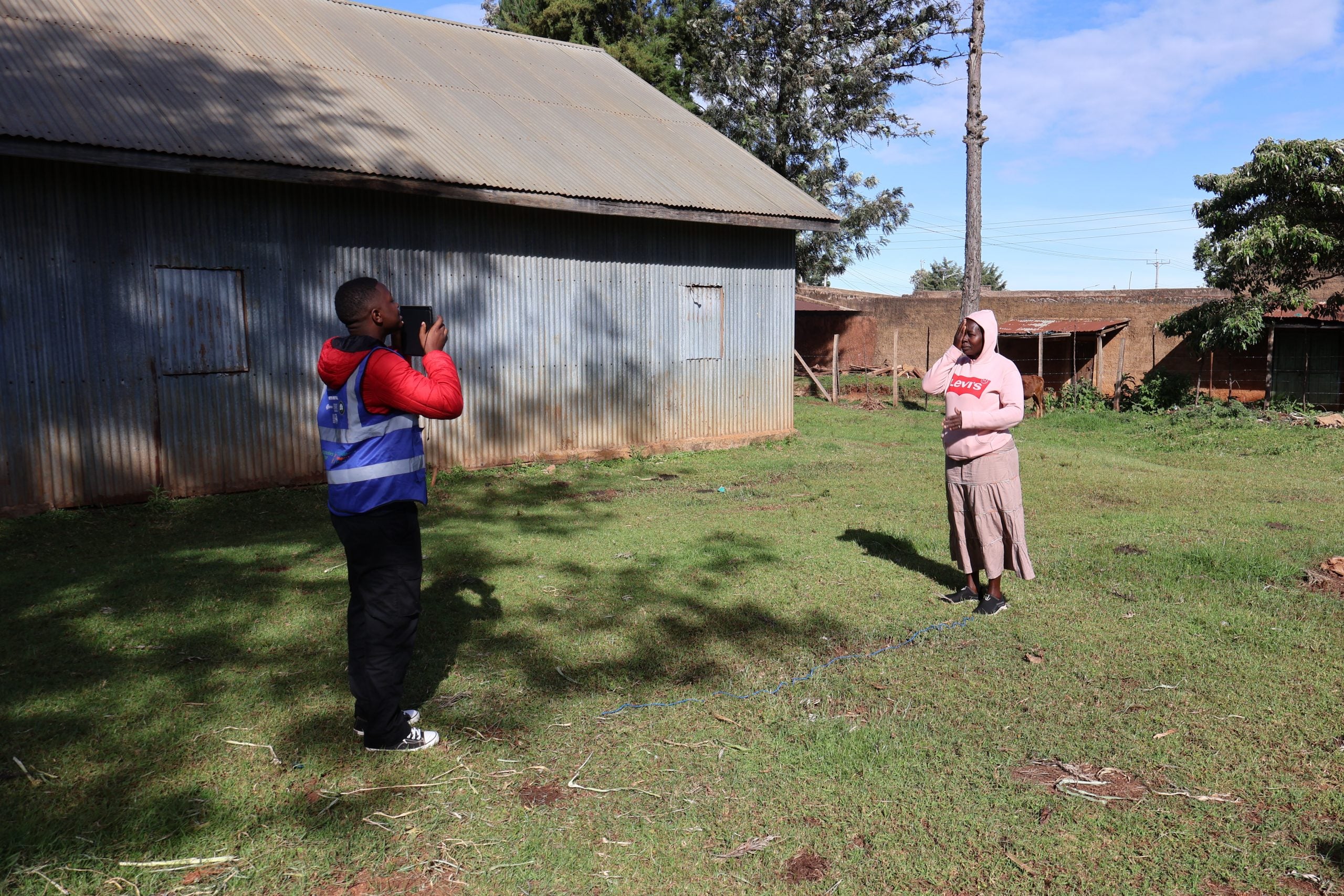
Vision testing in Kenya. Photograph: Hugh Bassett
A new study by the International Centre for Eye Health (ICEH) has identified barriers preventing younger adults in Kenya from accessing eye care, and developed practical solutions in partnership with the communities affected.
Published in BMJ Public Health, the research focused on Meru County in central Kenya, where a community eye screening programme had previously found that only 46% of people referred for eye care attended their free treatment clinic. Attendance was particularly low among adults aged 18–44, with fewer than one in three receiving care.
The programme, delivered through Kenya’s Vision Impact Programme (VIP) and part of ICEH’s Fair Access project, uses smartphone-based Peek Vision technology to screen people in their communities and refer those with eye problems for further assessment.
Researchers from ICEH, the Kenya Medical Research Institute, Kenya’s Ministry of Health, Peek Vision and collaborating organisations wanted to investigate why younger adults were less likely to attend and what could be done to improve access.
The team conducted 67 interviews with younger adults who had not accessed care, followed by surveys with 401 additional people to assess which proposed solutions were most likely to make a difference.
The main barriers included long queues at clinics, difficulties taking time away from work and inadequate information about appointments. Some participants reported leaving clinics after seeing queues of several hundred people, while others were unsure where or when to attend, what services would be provided or whether treatment would be free.
The researchers identified 25 potential solutions, including shorter waiting times, additional clinic sessions, clearer appointment information and improved counselling.
A workshop involving 15 representatives from community groups, healthcare providers, programme managers and other stakeholders then considered which interventions would offer the best balance of impact, affordability and feasibility.
The group selected improved counselling and SMS appointment reminders, including clearer information about clinic opening times, available services, potential costs and the importance of attending.
Although additional clinics and shorter queues were considered valuable, these changes were not affordable within the programme’s existing resources.
The research forms part of the wider IM-SEEN programme, which is developing approaches to identify and address inequalities in access to eye care across several countries.
The authors emphasise that improving equitable access requires understanding the experiences of people who are not receiving care, rather than relying solely on the views of healthcare providers.
The paper also reports that a subsequent randomised trial of the selected interventions increased attendance among younger adults from 32.1% to 39.0%, providing further evidence that relatively simple changes to communication can improve access.
The findings demonstrate how involving underserved communities in research and service planning can help identify practical changes to eye care programmes, with the potential to improve access for those who face the greatest barriers.
Publication
Allen LN, Karanja S, Gichangi M, Bunywera C, Muturi E, Gachobi D, Kathure P, Muasa EM, Mutwiri L, Kajuju L, Kagwiria F, Ntabathia B, Rono H, Macleod D, Kim M, Tlhajoane M, Burton MJ, Ramke J, Bolster NM, Bastawrous A. Identifying barriers and potential solutions to improve equitable access to community eye services in central Kenya: a rapid exploratory sequential mixed methods study. BMJ Public Health. September 2026. https://doi.org/10.1136/bmjph-2025-002856