
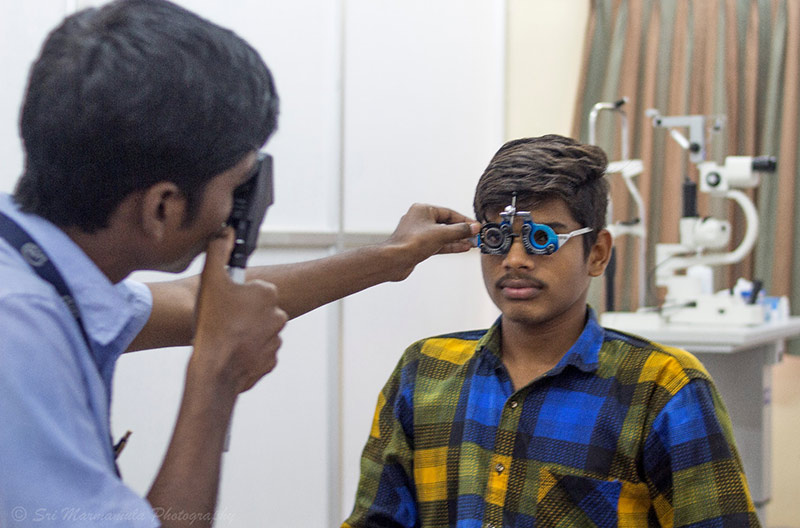
Refraction in India. Photograph: Dr Srinivas Marmamula / LVPEI
A 15-year population-based study from rural south India has found that around one in 12 people developed myopia over the follow-up period, providing some of the first long-term evidence on myopia incidence across both children and adults in India. The findings suggest that, although myopia remains a growing global public health concern, incidence in this rural population was lower than has been reported in many urban and East Asian settings.
Researchers followed participants from the Andhra Pradesh Eye Disease Study (APEDS), one of India’s longest-running population-based eye health studies. Of the 7,771 people originally examined in rural Andhra Pradesh, 5,395 (69.4%) were re-examined after an average of 15 years. After excluding people who already had myopia or cataract-related lens changes that could influence refraction, the analysis included 2,826 participants, ranging from children to adults.
Overall, the 15-year cumulative incidence of myopia was 8.0%, with remarkably similar estimates among participants who were under 30 years of age at baseline (8.0%) and those aged 30 years and older (7.8%).
Among younger participants, myopia developed more frequently in females than males, affecting 9.9% of females compared with 6.1% of males. After adjusting for other factors, females had 74% higher odds of developing myopia. Incidence also varied by location, with participants from the Mahabubnagar district having around twice the odds of developing myopia compared with those from West Godavari.
In contrast, among adults aged 30 years and older at baseline, current alcohol consumption was the only factor independently associated with incident myopia, with current drinkers having more than double the odds of developing myopia compared with non-drinkers. However, the authors caution that myopia developing later in adulthood may reflect age-related changes in the eye’s natural lens rather than the same biological processes responsible for childhood myopia.
One of the study’s most important findings was the influence of nuclear sclerosis, an age-related cataract change that can cause the eye to become more short-sighted. After excluding participants with significant nuclear sclerosis, myopia incidence declined steadily after the age of 30, suggesting that much of the apparent onset of myopia in older adults may actually be explained by changes in the crystalline lens rather than true adult-onset myopia.
The authors note that the study did not collect information on several recognised risk factors for myopia, including time spent outdoors, near work, digital device use and parental myopia, so these could not be assessed. Nevertheless, the findings provide valuable long-term evidence from a rural Indian population, helping to improve understanding of how myopia develops across the life course and providing an important benchmark against which future changes can be measured.
Publication
Prakesh WD, Khanna RC, Marmamula S … Murthy GVS, Gilbert C, Rao GN. Cumulative incidence of myopia and risk factors
in rural south India: results from the Andhra Pradesh Eye Disease Study III. Clinical and Experimental Optometry. July 2026. https://doi.org/10.1080/08164622.2026.2695842