
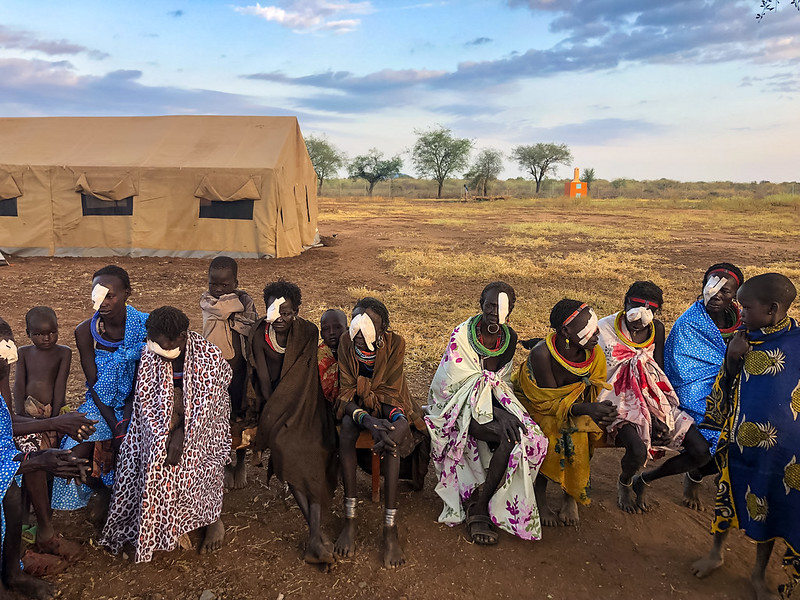
Recovering from trichiasis surgery Photograph: Katrina Sommers, The Carter Centre
A collaborative multinational study led by the International Centre for Eye Health has provided evidence on the clinical assessment of trachomatous trichiasis (TT), a sight‑threatening stage of trachoma that remains a leading cause of preventable blindness in many low‑income settings.
In TT, repeated Chlamydia trachomatis infections have caused the eyelid to turn inward, and eyelashes are rubbing against the cornea and causing scarring.
The research, conducted across Ethiopia, Uganda and Nigeria, examined how well assessment of trachomatous scarring (TS) by field graders employing a widely-used simplified World Health Organization grading system compared with detailed expert photographic assessment (tarsal conjunctival scarring – TCS).
Unmasking hidden scarring
The study, published in PLOS Global Public Health, addressed a long‑standing concern in trachoma surveillance and elimination programmes: whether the simplified TS sign used in field surveys sufficiently captures the true burden of conjunctival scarring that underpins trichiasis severity.
Teams enrolled hundreds of adults with trichiasis identified during community surveys in trachoma‑endemic districts of the three countries. Eyelid photographs from participants were then re‑graded by expert assessors using a detailed tarsal conjunctival scarring (TCS) grading system, and compared with the field‑based TS assessments recorded during the surveys.
In each country the percentage of trichiatic eyes graded ‘No TS’ in the field found to have TCS in expert grading were:
- Ethiopia – 92.8%
- Uganda – 67.9%
- Nigeria – 90.1%
In some locations, nearly 70% of eyes originally graded without scarring had extensive levels of TCS when reviewed by experts, indicating that simplified field grading may significantly underestimate the presence and severity of scarring among individuals with trichiasis.
The study also found that eyes with conjunctival scarring identified by expert grading were more likely to exhibit clinical features associated with severe disease – including pronounced entropion (inward eyelid rotation), inflammation and corneal opacity – underscoring the clinical relevance of accurately identifying conjunctival damage.
Implications for programmes and policy
These findings have clear implications for trachoma surveillance, programme planning and evaluation. Accurate measurement of scarring and disease severity is critical for determining the remaining burden of TT in communities approaching elimination thresholds, and for optimising surgical service needs and resource allocation.
The authors suggest that integrating more detailed scarring assessments – where feasible – can enhance the quality of programme data and better inform strategies to achieve and sustain trachoma elimination as a public health problem. Additionally, training and standardisation of grading practices in field surveys may help reduce misclassification and improve the targeting of surgical interventions.
This study provides evidence on the epidemiology and clinical assessment of advanced trachoma, supporting global efforts to eliminate this blinding disease through improved diagnostics and strengthened services.
Publication
Habtamu E, Mpyet C, Mugume F et al. Trichiasis with and without tarsal conjunctival scarring: A multi-country observational study. PLOS Global Public Health. October 2025. https://doi.org/10.1371/journal.pgph.0004356