
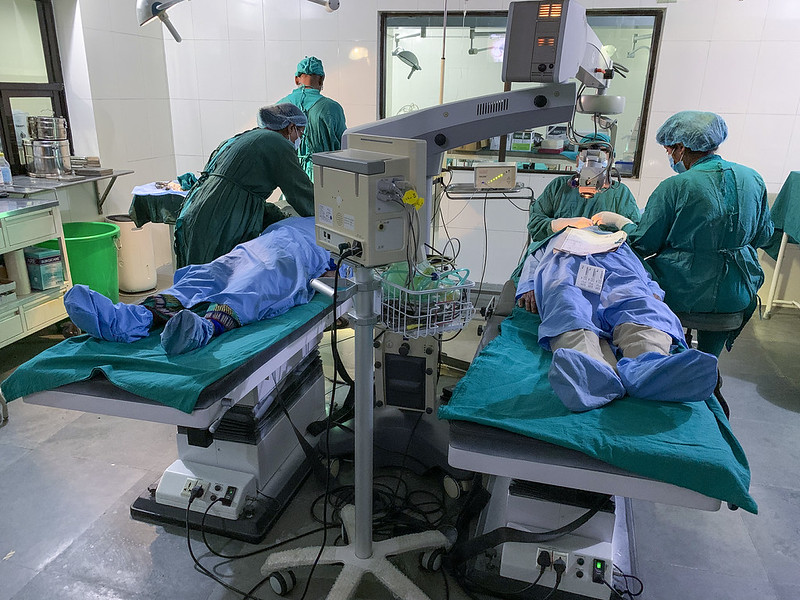
Photograph: Astrid Leck
A new study published in the British Journal of Ophthalmology provides important evidence on cataract surgery services in Nepal, showing high levels of surgical coverage but a continuing need to improve postoperative outcomes.
The work, including researchers from the International Centre for Eye Health, analysed Rapid Assessment of Avoidable Blindness survey data from all seven provinces of Nepal. In total, 32,565 people aged 50 years and older were examined between 2018 and 2021, making this the first national study to assess both cataract surgical coverage and the quality of outcomes across the country.
Nationally, cataract surgical coverage (CSC) at the <6/60 threshold was 82.7%, with similar coverage for women and men. This places Nepal close to a commonly cited WHO benchmark of 90% and compares favourably with many other low- and middle-income countries (LMICs). The authors note that Nepal’s CSC is higher than estimates recently reported from neighbouring India and China, despite Nepal’s challenging geography and lower national income.
However, there were important differences between provinces. Sudurpashchim Province had the highest coverage at 92.2%, while Madhesh and Lumbini had the lowest, at 77.6% and 75.4% respectively. Interestingly, the densely populated Terai provinces had lower coverage despite housing many of Nepal’s major eye care centres. The authors suggest that outreach and peripheral eye camps may have helped more remote provinces achieve stronger results.
The study also examined effective cataract surgical coverage (eCSC), which combines access to surgery with achieving a good visual outcome. National eCSC at the <6/12 threshold was 35.4%, considerably lower than overall surgical coverage. This means that while many people are receiving surgery, fewer are achieving the level of postoperative vision considered optimal under current WHO guidance.
Compared with other LMIC settings, Nepal’s eCSC is broadly similar to estimates recently reported from India, but remains below current global averages. The study identified a 47.3% relative quality gap between CSC and eCSC nationally, highlighting the challenge of translating surgical volume into consistently strong visual outcomes.
Nepal’s cataract services are strongly supported by the voluntary and non-governmental sector. Almost 80% of surgeries were performed through charitable hospitals and eye camps, with charitable hospitals alone accounting for 62.9% of all procedures.
Outcomes varied by place of surgery. The proportion of surgeries achieving very good presenting vision was highest in private hospitals, followed by government and charitable hospitals, and lowest in eye camps. Pinhole testing substantially improved visual acuity results, suggesting that postoperative refraction and spectacle provision could significantly improve outcomes.
Among poor outcomes, 60.9% were linked to preoperative ocular comorbidity, while 16.9% were due to intraoperative complications. The authors argue that better biometry, stronger follow-up systems, clinical audit, postoperative refraction, and spectacle dispensing could help narrow the gap between cataract surgical coverage and effective coverage.
The study concludes that Nepal has built a strong cataract delivery system with high surgical reach and good gender equity. However, as in many LMICs transitioning from expanding access to improving quality, the next challenge will be ensuring that more patients not only receive surgery, but regain good functional vision afterwards.
Publication
Shah R, Mishra SK, Gogate PM et al. Coverage of cataract surgery services in Nepal: results from a nationwide Rapid Assessment of Avoidable Blindness survey. British Journal of Ophthalmology. April 2026. https://doi.org/10.1136/bjo-2025-327397