
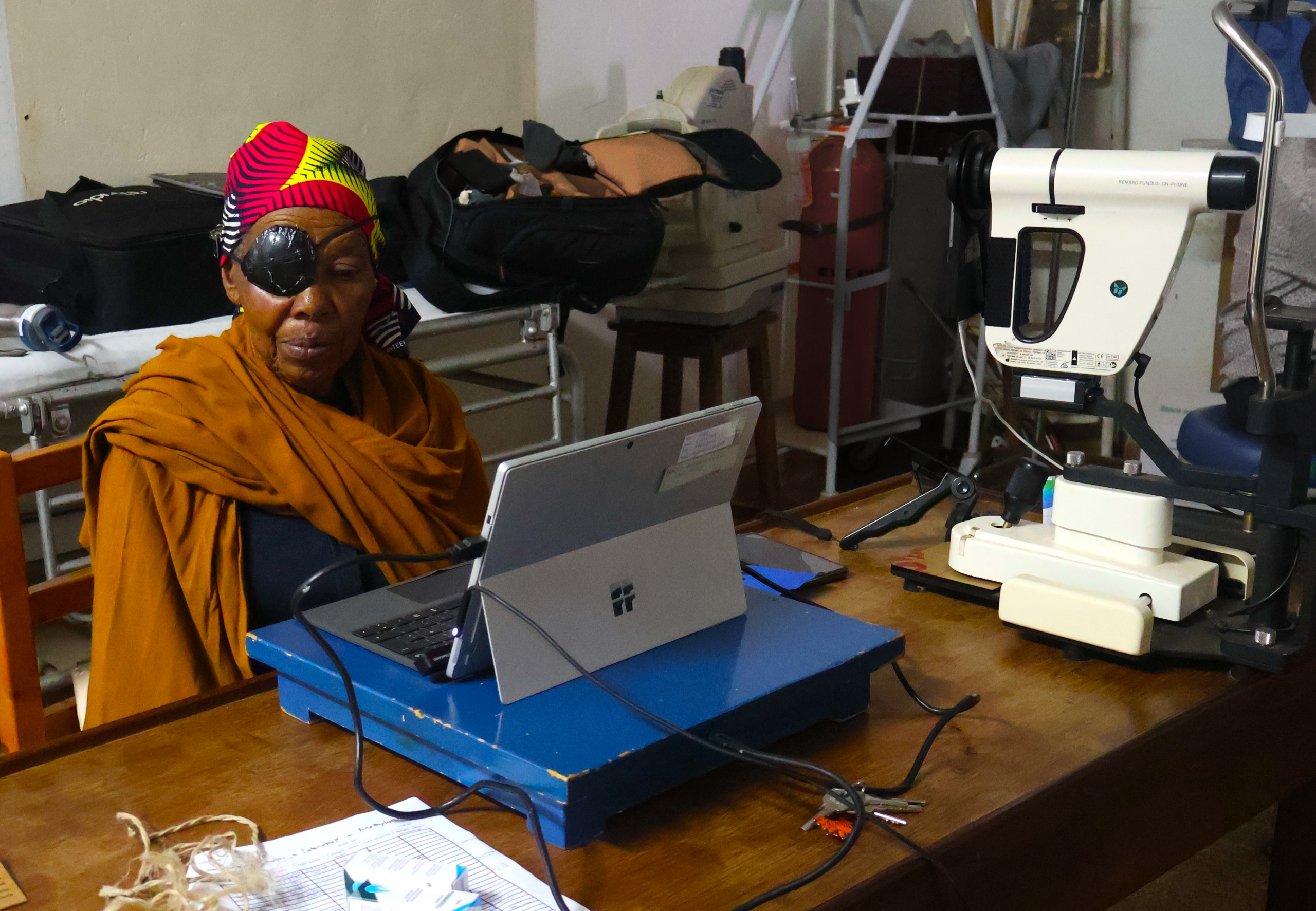
A new study involving researchers from the International Centre for Eye Health (ICEH) has found that a portable, tablet-based eye test could help identify people with significant visual field loss in Tanzania, although technical limitations currently restrict its usefulness in clinical practice.
Published in PLOS Global Public Health, the research evaluated eye movement perimetry (EMP), a technology that uses eye tracking to assess a person’s visual field (without the need for conventional, expensive testing equipment), in a low-resource area in Tanzania.
The study found that EMP correctly identified all participants with moderate to severe visual field defects, but also flagged many people who did not have significant visual field loss, potentially creating unnecessary demand for further investigations.
Glaucoma is the leading cause of irreversible blindness worldwide. Early detection and treatment can slow its progression, but diagnosis can be challenging, particularly in lower-resource settings where specialist equipment and trained professionals are limited.
One of the principal methods of assessing glaucoma is standard automated perimetry (SAP), which measures a person’s visual field using specialised equipment. However, these machines are expensive, relatively large and require trained operators, limiting their availability in many settings.
Researchers from ICEH, Kilimanjaro Christian Medical Centre (KCMC) in Tanzania, City St George’s, University of London, and other collaborating institutions investigated whether a simpler, more portable alternative could help determine which patients need further glaucoma testing.
Testing a portable alternative
The study recruited 248 adults, contributing 480 eyes, attending ophthalmology clinics at KCMC in Moshi, Tanzania, between March 2022 and December 2023.
Participants were asked to complete an eye movement perimetry test using a tablet computer fitted with an eye-tracking device. Rather than looking at a fixed point and pressing a button when they see a light, as required in conventional visual field testing, participants simply looked towards lights appearing at different locations on the screen.
The eye tracker recorded their responses, allowing the researchers to assess whether they had detected each stimulus. Participants also underwent conventional visual field testing, enabling a comparison between the two methods.
The researchers were particularly interested in whether EMP could be used as an initial triage test, identifying people unlikely to have significant visual field loss and reducing the number requiring more expensive specialist investigations.
In an analysis simulating how EMP might be used to triage 232 participants, the test achieved 100% sensitivity for detecting moderate to severe visual field defects. This meant that every participant with this level of visual field loss was correctly identified as requiring further investigation.
However, the test achieved a specificity of just 20.7%, meaning that nearly four in five participants without a significant visual field defect would still have been referred for further testing.
Overall, 201 of the 232 participants (86.6%) would have required further investigation under the proposed triage criteria, substantially limiting the potential to reduce demand for conventional testing.
Technical difficulties compounded this problem. EMP testing could not be completed in 75 of the 480 eyes (15.6%), while data export or processing failed for a further 35 eyes (7.3%). The most common difficulties involved initial calibration and unreliable eye-tracking measurements.
Despite these limitations, the researchers found that EMP results correlated with conventional visual field measurements and could often identify the location of visual field defects.
Participants also generally preferred the portable test. 63.1% agreed that EMP was easy to complete, while 55% said it was easier than conventional testing.
Improving access to glaucoma diagnostics
The findings highlight both the opportunities and challenges of introducing portable glaucoma diagnostic technologies in lower-resource settings.
A rapid, affordable test that reliably identifies people without significant visual field loss could reduce unnecessary journeys to specialist clinics, ease pressure on limited diagnostic services and help patients access appropriate care sooner.
However, the researchers emphasise that a useful triage system must not only identify people with significant visual field defects, but also avoid referring large numbers of people who do not need further investigation.
The study was conducted at a single centre, and the researchers recommend further development to improve eye-tracking reliability and reduce test failures, followed by larger prospective evaluations.
The authors conclude that while EMP demonstrated excellent sensitivity for significant visual field loss in this study, its low specificity currently limits its practical value as a triage tool. Improvements in the technology could help make portable visual field testing a more effective option for glaucoma services in settings where conventional equipment is difficult to access.
Publication
Thirunavukarasu AJ, Hu VH, Jones PR, Taylor EH, Matayan E, Mbishi S, Macha E, Mtuy T, Crabb DP, Makupa W, Burton MJ, Philippin H. Feasibility and performance of eye movement perimetry for glaucoma triage in Tanzania: A prospective cross-sectional study in a real-world setting. PLOS Global Public Health. 2026;6(9). https://doi.org/10.1371/journal.pgph.0007237