
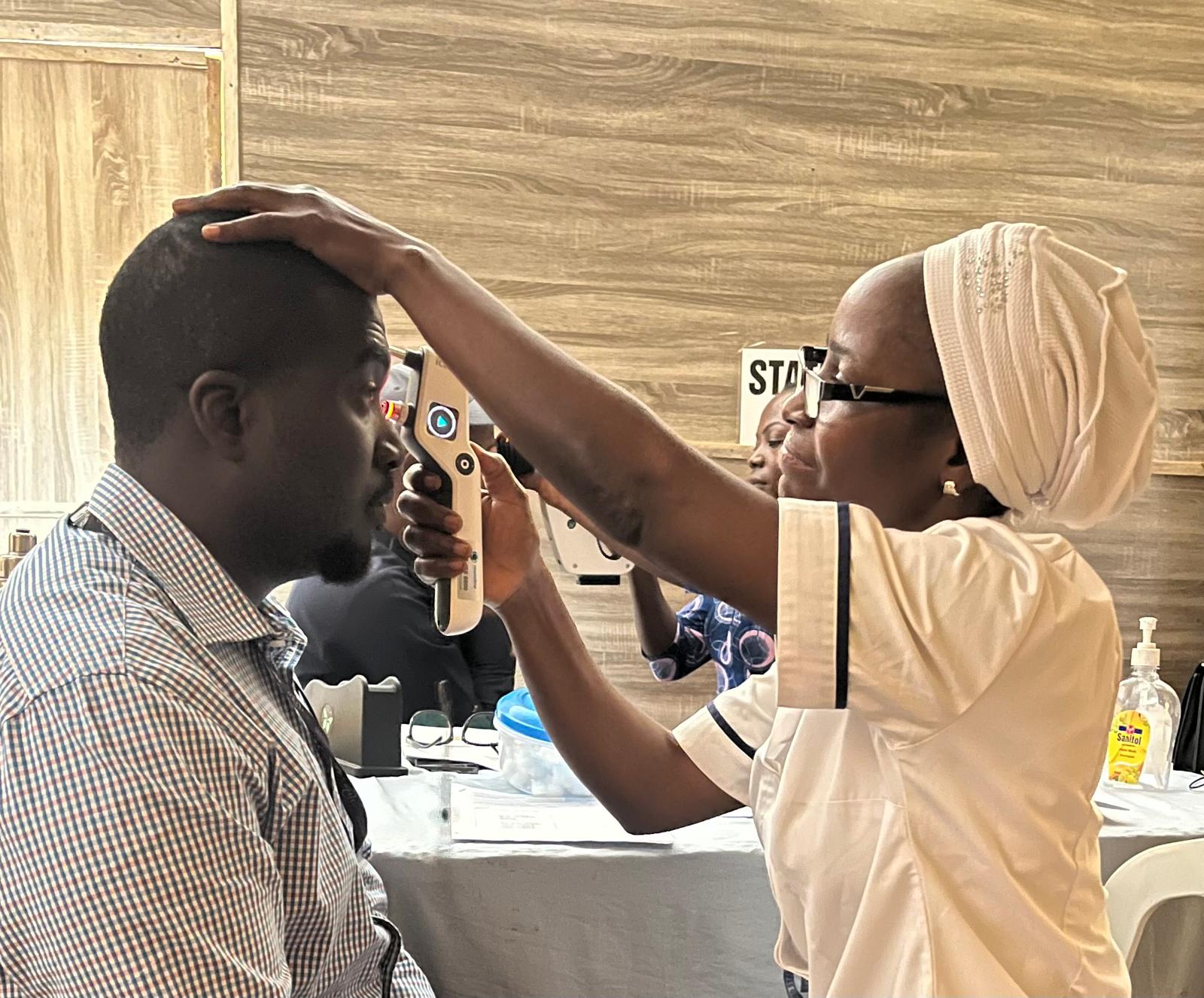
New research provides robust evidence that portable, low-cost diagnostic tools can perform comparably to standard glaucoma testing and are feasible for health workers to use, offering a potential pathway to expand case finding in low- and middle-income countries (LMICs).
Glaucoma is a leading cause of irreversible blindness worldwide, with the greatest burden falling on LMICs. Early detection is critical, yet diagnosis typically relies on expensive equipment and highly trained specialists, both of which are often limited. This new study, led by researchers from the International Centre for Eye Health, evaluated a suite of portable devices against conventional diagnostic tools in a clinical setting in Nigeria.
The study assessed 312 participants (a total of 524 eyes) using both portable and conventional tests, comparing tools across key indicators used to diagnose glaucoma:
- Contrast Sensitivity – Peek CS was compared to Pelli-Robson chart testing
- Visual Acuity – Peek Acuity compared to LogMAR
- Intraocular Pressure – iCare compared to Goldmann Applanation Tonometry (GAT)
- Visual Fields – Eyecatcher vs Humphrey Field Analyzer
- Optic Discs – Remedio handheld fundus camera vs slit lamp
Results showed strong agreement between portable and standard methods.
Intraocular pressure measurements using a handheld iCare tonometer were highly correlated with Goldmann applanation tonometry (r = 0.96), while smartphone-based visual acuity testing (Peek) also showed good agreement with LogMAR charts (r = 0.82).
Among the devices tested, a handheld fundus camera achieved the highest diagnostic accuracy, with an area under the curve (AUC) of 0.91, sensitivity of 82.4%, and specificity of 99.8% for detecting glaucoma-related optic nerve changes.
Combining different portable tests further improved performance, with multimodal approaches achieving AUC values of up to 0.86 (Remedio with Eyecatcher).
Importantly, the study also found that portable devices were faster to use, had higher completion rates, and were strongly preferred by patients, suggesting they may be particularly well suited to high-volume or community-based screening settings. (For example, in comparing the Remedio fundus camera to slit lamp testing, only 1% of participants preferred the slit lamp)
These findings are reinforced by complementary research which demonstrated that community health workers can be trained to use portable glaucoma diagnostic tools effectively in primary care settings. In three community health centres in Abuja, Nigeria, fifteen community health workers were trained in using Peek Acuity, iCare tonometer, Eyecatcher and Remedio. All the health workers achieved scores of 80% or higher on assessments, showing signficant improvement in knowledge and proficiency. This highlights not only the technical performance of these devices, but also their potential to support task-sharing models that extend eye care beyond specialist clinics.
Taken together, the evidence suggests that portable diagnostic tools could play a critical role in addressing the large proportion of undiagnosed glaucoma cases, particularly in settings where access to ophthalmologists and conventional equipment is limited. By enabling earlier detection, streamlined referral, and decentralised screening, these technologies could help reduce preventable vision loss at scale.
The authors emphasise that while results are promising, further validation in community settings will be essential. Nonetheless, these studies mark an important step toward more accessible, scalable glaucoma detection, aligning with global efforts to strengthen eye health systems and reduce inequalities in access to care.
Publications
Garba F, Kyari F, Burton M, Hu V, Macleod D, Jones P, Bello M, Ibrahim A, Diala G, Ada AR, Ezurike K, Ajefu MO, Yohanna A, Nolan W. Comparison of portable devices with standard glaucoma diagnostic testing for the detection of glaucoma for the purposes of glaucoma case finding in low-and middle- income countries. Eye. February 2026. https://doi.org/10.1038/s41433-026-04297-4
Garba F, Nolan W, Burton M, Hu V, Ada AR, Ezurike K, Ajefu MO, Kyari F. Glaucoma detection training of community healthcare workers using portable devices in Nigeria. Frontiers in Public Health. January 2026. https://doi.org/10.3389/fpubh.2025.174041